Healthcare providers spend nearly 16 minutes on electronic health records for every patient visit. Errors in these records affect up to 70% of them. These mistakes can harm patient safety and raise your practice’s liability risks.
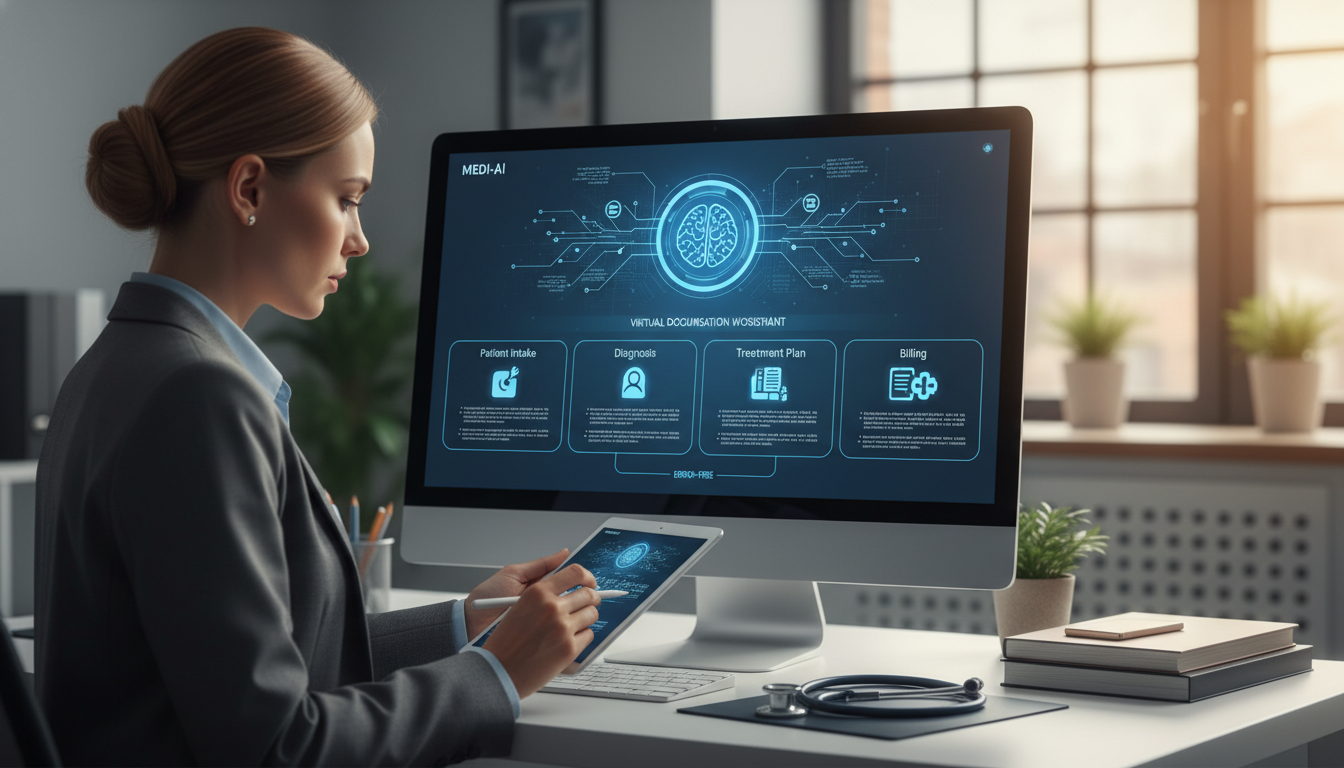
Your healthcare practice is under pressure to keep records accurate while caring for patients. The complexity of electronic systems is growing. This leaves you with less time for your patients. Virtual medical assistant EHR documentation is a proven solution to this problem.
Remote professionals offer EHR data entry support to reduce errors and make your workflows smoother. They handle the time-consuming data entry tasks. This keeps your patient records accurate and up to date. You get more time for patient care while keeping records precise.
This article shows how remote team members change your practice’s electronic records management. They solve common documentation problems.
Key Takeaways
- Documentation errors affect up to 70% of clinical records, creating significant risks for healthcare practices
- Remote professionals provide specialized support that reduces data entry mistakes and improves record accuracy
- Healthcare providers can reclaim valuable time previously spent on administrative record-keeping tasks
- Trained specialists ensure compliance with healthcare regulations while maintaining patient record integrity
- Streamlined workflows allow you to focus more attention on direct patient care activities
- Professional data entry support creates cost-effective solutions for growing documentation demands
Understanding Virtual Medical Assistants in Healthcare
Virtual medical assistants bring special skills to your practice. They work from home and don’t need a physical office. They help with your documentation needs and fit right into your workflow.
The need for clinical documentation outsourcing is growing. This means your practice can work more efficiently. Virtual medical assistants help your team focus on patient care. This is a big change in how you handle paperwork.
What Virtual Medical Assistants Are
A virtual medical assistant is a healthcare expert who works from home. They help with paperwork and don’t need to be in your office. They use digital platforms to work with your electronic health records.
They do tasks that used to need someone to be in your office. With remote charting, they update patient records and more. This way, you can get help from anywhere.
The main difference between virtual and traditional assistants is where they work. Virtual assistants use technology to do tasks that used to need face-to-face work. They are just as professional but offer more flexibility.
Key Responsibilities in Your Practice
Virtual medical assistants handle many tasks to keep your practice running smoothly. They work on different parts of healthcare administration. They make sure your medical records are accurate and complete.
Their main jobs include:
- EHR data entry and maintenance – They put patient info and test results into your electronic health record system with care
- Patient chart updates – They make sure all patient visits are documented right away and correctly
- Appointment scheduling documentation – They record any changes or cancellations in your system
- Insurance verification records – They handle insurance info, confirmations, and authorizations
- Clinical note preparation – They help organize and format clinical notes according to your standards
They work when it’s best for your practice. They use remote charting technology to access your systems and do tasks in real-time. This keeps your records up to date without delays.
They also handle letters, prescription refills, and tracking referrals. They keep detailed logs of patient talks and make sure everything is recorded. This helps keep care consistent across your practice.
Advantages for Your Healthcare Facility
Using virtual assistance through clinical documentation outsourcing brings big benefits. You get specialized skills without the costs of full-time employees. This saves money and keeps your documentation quality high.
The benefits you see include:
- Enhanced documentation accuracy – Virtual assistants focus on paperwork, reducing mistakes from multitasking
- Reduced administrative burden – Your doctors and nurses have more time with patients
- Extended coverage hours – Virtual assistants work across different time zones, helping beyond office hours
- Scalability based on demand – You can adjust hours as needed, based on patient volume and seasons
- Cost savings – Cutting costs on office space, equipment, and benefits saves money
Virtual assistants also make your paperwork faster. They work quicker than staff who are already busy. This means you meet deadlines and follow rules better.
Virtual assistance lets you get help for specific needs. Some virtual assistants specialize in certain areas or types of paperwork. You can find the right expert for your practice.
Virtual assistants fit into your workflow easily. They use your EHR systems and follow your rules. This makes working with them as smooth as working with your team.
The Importance of Accurate EHR Documentation
Keeping your EHRs accurate is key to protecting your practice and improving care. Every entry in a patient’s record is part of their medical history. These records affect treatment, insurance, and legal actions.
Accurate documentation is vital for three main reasons. It keeps your practice in line with laws. It ensures high-quality care for patients. It also helps your practice financially by avoiding billing mistakes.
EHR data entry support is essential for maintaining high standards. Virtual medical assistants bring the needed skills and focus to this task. They help your team meet regulations while you focus on patient care.
Legal Requirements and Compliance
Your practice must follow strict rules for EHRs. HIPAA sets privacy and security standards. Breaking these rules can lead to big fines.
CMS has rules for using EHRs to improve care. Not following these can cut Medicare payments by up to 5%.
State boards also have rules for EHRs. These cover things like prescription tracking and consent forms. Keeping accurate records is key to keeping your license.
“Accurate documentation is not just a legal requirement—it’s the foundation of quality healthcare and patient safety.”
EHR data entry support from virtual assistants helps meet all these rules. They stay up-to-date with laws and follow standard processes. This reduces risks and keeps records consistent.
Your practice faces many challenges with EHRs. Issues like missing signatures and delayed entries can lead to penalties. Professional support helps avoid these problems.
| Compliance Area | Documentation Requirement | Penalty for Non-Compliance | Support Solution |
|---|---|---|---|
| HIPAA Privacy | Secure patient information access logs | $100-$50,000 per violation | Automated tracking and audit trails |
| Meaningful Use | Clinical quality measure reporting | Up to 5% Medicare payment reduction | Standardized data entry protocols |
| State Licensing | Complete encounter documentation within 24 hours | License suspension or revocation | Real-time documentation support |
| Medicare Conditions | Signed and dated provider orders | Claim denials and recoupment | Verification and completion checks |
Impact on Patient Care
Good documentation is key to patient safety. Accurate records help your team make better decisions. Bad data can lead to mistakes and harm patients.
Studies show that documentation errors cause about 80% of serious mistakes. Incomplete records can lead to medication errors and delayed diagnoses. These errors can harm patients and put your practice at risk.
Accurate EHRs are essential for care coordination. When patients see different doctors, their records must be complete. This helps other providers understand their care history.
Professional EHR data entry support ensures your records are complete. Virtual assistants check for errors and missing data. This helps your team focus on patient care.
Patient care improves when records are accurate. Referrals are made quickly, and test results are documented correctly. This reduces the need for repeat tests.
Clinical decision support systems rely on accurate data entry. These systems alert providers to drug interactions and suggest treatments. Without accurate data, these systems can’t protect patients.
Reducing Healthcare Costs
Accurate documentation saves money. Insurance companies deny claims due to bad documentation. This affects your practice’s income.
Doctors spend $15.4 billion annually on claim rework. Denied claims take time to fix and resubmit. This diverts resources from patient care.
Good records prevent unnecessary tests. This saves money and reduces risks. It also improves patient care.
EHR data entry support saves money in many ways. Virtual assistants work faster than clinical staff. This speeds up billing and improves cash flow.
Your malpractice insurance is based on your documentation quality. Practices with good records face fewer lawsuits. This makes your practice safer.
Professional support helps you get the right reimbursement. Many practices under-code due to bad records. Virtual assistants ensure accurate billing.
The cost of EHR data entry support is worth it. It saves money through fewer denials and better billing. These benefits grow as your practice improves.
How Virtual Medical Assistants Enhance EHR Documentation
Using virtual medical assistants can make your practice better at EHR documentation. They use special methods to make records fast and accurate. This lets your team focus more on patient care.
Virtual medical assistants make your documentation process better. EHR data entry support becomes a big help, not a hassle. Your practice will see better times for getting records done, better data quality, and happier doctors.
Streamlining Data Entry Processes
With virtual medical assistants, your team works faster. They create rules for getting patient info and organizing notes. This makes data entry quicker and less confusing.

They also use templates to speed up writing. This means doctors spend less time typing the same things over and over. They can focus on what’s unique to each patient.
They also know what to do first. Remote charting tasks are done in order of importance. So, important updates get done right away.
They also avoid typing the same thing twice. This saves time and keeps information accurate. They update many places at once, making work easier.
Good EHR documentation needs to be fast and accurate. Virtual medical assistants make this happen with their systematic ways.
Having EHR data entry support helps a lot. Your EHR system gets updates quickly. This lets doctors and nurses spend more time with patients.
Ensuring Consistency Across Records
Virtual medical assistants keep records the same everywhere. They follow rules for how to write and organize information. This makes records easy to understand for everyone.
They use the right medical terms. This avoids confusion in your EHR system. Your records are more reliable for making decisions and talking to other doctors.
They also organize information in a certain way. This makes it easy to find what you need. It also helps avoid missing important details.
They check that information is correct everywhere. This stops mistakes before they cause problems. It keeps your EHR system safe and accurate.
- Documentation Style Uniformity: All entries are the same, no matter who wrote them
- Terminology Standardization: Medical terms and codes are always correct
- Chronological Coherence: Patient care events are in the right order
- Cross-Reference Validation: Information in different places is always right
Virtual medical assistants make your records better in many ways. They help doctors make decisions and keep your practice safe. They show you care about quality and follow the rules.
Common Challenges in EHR Documentation
Knowing the common problems in electronic health records helps you see where your practice needs help. Healthcare places across the country face many challenges. These issues affect how well records are kept, how fast they are done, and how safe patients are.
These problems are not just random. They are big issues that affect many medical practices everywhere.
Transcription Mistakes and Data Entry Errors
Your practice likely has many data entry mistakes. These mistakes happen when doctors or nurses type wrong information during busy times. These errors can affect how patients are treated and how bills are paid.
Another big problem is when important parts of patient records are left blank. This can happen when doctors are interrupted or unsure what to write. It makes it hard to keep track of patient history.
Copy-and-paste mistakes also cause problems. When staff copy old information without checking, wrong info spreads. It saves time but leads to mistakes later.
Getting patients mixed up is very dangerous. Mistakes in names or birth dates can lead to wrong treatments. These mistakes can be very serious.
Errors in medication dosages are another big risk. A small mistake can make a safe medicine dangerous. Professional EHR data entry support helps avoid these risks.
Mistakes in coding can hurt your practice’s money. Wrong codes can lead to denied claims and less money. These mistakes happen when staff rush or don’t know the codes well.
These mistakes come from tired doctors, distractions, not enough training, and the need to document fast.
Inconsistent Documentation Practices
Every doctor in your practice might do things differently. This makes it hard for others to understand the records. It’s like trying to find a needle in a haystack.
Some doctors write a lot, while others write very little. This makes it hard for others to know what’s missing. It’s like trying to read a book with missing pages.
Doctors use different words for the same thing. This makes it hard to find patterns in patient records. It’s like trying to find a pattern in a puzzle with missing pieces.
These differences make patient stories hard to follow. Specialists have a hard time understanding the whole story. It’s like trying to read a book with missing chapters.
Using the wrong templates is another problem. Doctors might use the wrong template or change it too much. This makes the records very different from each other.
Insufficient Time for Thorough Documentation
Doctors have too much to do and not enough time. They spend almost half their day on EHR tasks instead of seeing patients. This means they don’t have enough time to document well.
The need to see more patients makes doctors rush. They might not document everything or might use shortcuts. This leads to mistakes and missing information.
Waiting to document can lead to mistakes. Doctors might forget important details. It’s like trying to remember a story from a long time ago.
Too much documentation can make doctors very tired. The constant need to document can make them unhappy and want to leave. This makes it hard to keep good records.
Doctors often work late to finish their charts. This means they don’t have time for themselves. It’s hard to keep good records when you’re tired.
These time problems affect everything in your practice. Patients might not like it when doctors are on their phones. It also makes it hard to get paid on time.
Professional EHR data entry support from virtual medical assistants solves these problems. They have the time and training to do it right. They make sure everything is consistent. This lets doctors focus on patients and keeps records accurate.
The Role of Technology in EHR Documentation
Advanced software and security help virtual medical assistants work on EHRs remotely. They use top electronic health record systems and tools for remote charting. This setup keeps patient records accurate and helps reduce doctor burnout.
Virtual assistants work in a secure digital space. They use many security layers, platforms, and tools that work well together. This shows how they can handle your documentation needs well and safely.
Software Tools Used by Virtual Medical Assistants
Virtual medical assistants use many software tools for remote charting. They are trained on big EHR platforms your practice might use. This makes their work fit right in with yours.
They use systems like Epic, Cerner, and Athenahealth. These tools help them document patient visits well. They can quickly learn your specific software.
They also use special tools to make their work faster and more accurate. For example, speech recognition software turns spoken words into text quickly. Secure messaging lets them talk with your team without risking patient privacy.
They can also see scheduling and billing info. Quality checks help them make sure records are complete and right. These tools make sure EHRs are done right.
| EHR Platform | Primary Features | Documentation Capabilities | Security Protocols |
|---|---|---|---|
| Epic | Integrated clinical workflows, patient portal, billing integration | Real-time charting, template customization, voice recognition support | Role-based access, audit logging, encrypted data transmission |
| Cerner | Population health management, interoperability, analytics dashboard | Smart documentation, clinical decision support, mobile accessibility | Multi-factor authentication, session timeouts, compliance tracking |
| Athenahealth | Cloud-based platform, revenue cycle management, patient engagement | Point-and-click charting, order entry, remote access functionality | HIPAA-compliant hosting, automatic backups, data encryption |
| eClinicalWorks | Telemedicine integration, patient check-in, prescription management | Customizable templates, scanning capabilities, progress note automation | Secure messaging, access controls, activity monitoring |
Integration with Existing EHR Systems
Adding virtual medical assistants to your EHR system needs secure remote access protocols. Your practice sets up VPN connections for safe data sharing. This keeps patient info safe during transfer.
Role-based access controls are key. Your IT sets up rules for what each virtual assistant can do. This keeps their access limited to what they need.
Audit trails track all actions in your EHR system. They log login times, patient charts, and changes. This helps with security and following rules.
End-to-end encryption keeps data safe. Virtual assistants’ work is encrypted before it reaches your servers. Multi-factor authentication adds extra security.
HIPAA-compliant channels help your team work together safely. They share info without using insecure email. Regular training keeps everyone up to date on data protection.
Cloud systems make teamwork easy. Changes made by virtual assistants are seen right away. This keeps everyone working with the latest info.
Training and Qualifications of Virtual Medical Assistants
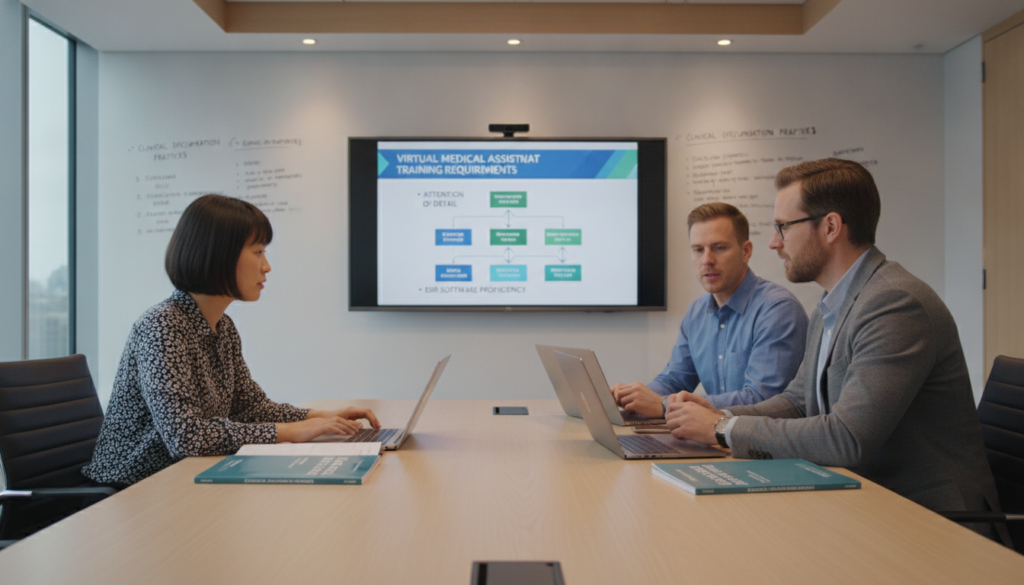
Knowing what virtual medical assistants are trained in helps you choose the right clinical documentation outsourcing for your healthcare. These professionals have the education and training needed for accurate records. Working with a trusted service means your EHR systems will be in good hands.
These assistants go through detailed training before helping your practice. Their skills ensure your records are always correct and complete.
Educational Background Requirements
Virtual medical assistants usually finish accredited programs. These programs teach them the basics of healthcare. This knowledge helps them understand the medical side of your records.
They also learn medical terminology. This lets them accurately interpret and document clinical information without mistakes. Their education keeps your records precise and clear.
They also study anatomy and physiology. This helps them understand the body and medical conditions better. They can spot and correct errors in your records.
They get special training in healthcare documentation. This includes learning how to format records and use the right terms. Your clinical documentation outsourcing partner makes sure they get this training.
EHR system certification is key. It shows they know how to use complex electronic health record systems. You can trust they handle your records well.
| Credential Type | Issuing Organization | Primary Focus Area | Renewal Requirement |
|---|---|---|---|
| Certified Medical Assistant (CMA) | American Association of Medical Assistants | Clinical and administrative medical assisting | 60 credits every 60 months |
| Registered Medical Assistant (RMA) | American Medical Technologists | Medical procedures and documentation | 30 points every 3 years |
| Certified Healthcare Documentation Specialist (CHDS) | Association for Healthcare Documentation Integrity | Medical record documentation accuracy | 30 credits every 3 years |
| Registered Health Information Technician (RHIT) | American Health Information Management Association | Health information management and coding | 20 credits annually |
Many virtual medical assistants have certifications like CMA or RMA. These show they meet national standards. When you outsource your documentation, these credentials mean a lot.
They also have special certifications in health information management. This means they know a lot about medical records and following rules. Your records get better because of their knowledge.
Good virtual medical assistant services look for candidates with healthcare experience. This ensures they know how to document medical information well.
Having healthcare experience helps virtual medical assistants a lot. They know how to document patient information correctly. They understand how important it is to do it right and on time.
Ongoing Training and Certification
The healthcare world is always changing, and virtual medical assistants need to keep up. Good clinical documentation outsourcing providers make sure their teams get ongoing education. This keeps them up-to-date with new things in healthcare.
They also learn about EHR updates and new features. This means they can use the latest tools without any problems. Your documentation workflow stays smooth.
They also get training on HIPAA compliance. This keeps patient information safe. You can relax knowing your records are protected.
They get training in specific medical areas too. This means they know how to document for your specialty. Your records get more accurate and relevant.
They also learn about quality assurance. This helps them check their work for mistakes. Your records get checked multiple times to catch errors early.
They learn about new healthcare technology too. This includes things like artificial intelligence and voice recognition. They get trained on how to use these tools. Your documentation stays up-to-date with technology.
They also have to keep their certifications current. This means they keep learning and getting better. You work with professionals who are always improving.
This focus on training and certification is a big plus for your practice. They stay informed about new rules for medical records. They can quickly adapt to new standards.
This training and certification mean you get the best for your practice. You have professionals who focus on making your records perfect. Their education and ongoing training make sure your records are accurate and complete.
Best Practices for Effective EHR Documentation
Creating a good EHR system starts with clear rules from the beginning. Your virtual medical assistants need clear rules, consistent standards, and regular feedback. This helps them do their job well.
To make your documentation top-notch, focus on both process and quality checks. You’ll create systems for daily work and checks to find and fix problems early.
Creating Documentation Standards That Work
First, make detailed rules for how EHR data entry should work in your practice. These rules are like a map for your virtual medical assistants.
Set clear time limits for different types of documents. For example, routine notes should be done in 24 hours. Urgent documents need to be done right away. This avoids confusion and keeps records up to date.
Make a list of the terms and abbreviations you prefer. This keeps all patient records the same. Include approved medical abbreviations, terms for specific areas, and how you name procedures or conditions.
Your rules should also say how to organize charts. This should match how doctors look at patient info. Include:
- Standard section headings for notes
- Ordering of vitals, meds, and allergies
- How to format test results and reports
- Templates for common visits or procedures
- Where to put patient messages
Set up ways for your team and virtual assistants to talk. Decide when to use messages, email, or calls. Regular talks help solve problems fast and avoid delays.
Make plans for when things are unclear. Say who to call, how long to wait, and how to flag things for doctors.
Make a list of what’s most important to do first. Things like emergency notes or lab results are top priority.
Implementing Quality Assurance Systems
Regular checks are key to good EHR records. You need to review records often to check for mistakes, find ways to get better, and give feedback to your team.
Do random chart reviews weekly or monthly, depending on how much you do. Pick charts that show different types of visits and providers. This helps you see how well your team is doing.
Look for common mistakes like:
- Right patient info
- Correct meds and dosages
- Full list of problems
- Right codes for diagnoses and procedures
- Good reasons for what you did
Compare your team members to see who’s doing well. This shows who’s doing great and who needs more practice.
Use tools in your EHR system to find mistakes. These tools can spot missing info, wrong data, and things that don’t look right.
Keep track of how well your team is doing. Look at error rates, how fast they finish, and how well they follow rules. This shows if your efforts to improve are working.
| Quality Metric | Measurement Method | Target Benchmark | Review Frequency |
|---|---|---|---|
| Documentation Accuracy | Random chart audits | 98% or higher | Weekly |
| Completion Timeliness | Timestamp analysis | 95% within deadline | Daily |
| Coding Precision | Billing report review | 99% correct codes | Monthly |
| Protocol Compliance | Checklist verification | 100% adherence | Bi-weekly |
Have a way to give feedback that helps everyone get better. Talk about mistakes right away. Try to understand why they happened and how to avoid them.
It’s also important to praise good work. Acknowledge when someone does a great job or improves. This keeps your team happy and motivated.
Have regular training to help with common problems. This keeps your team up to date with best practices and new EHR features.
Working with virtual medical assistants needs a mutual commitment to doing things right. Clear rules, open communication, and regular checks are key to making sure records are accurate and help patients get the best care.
Case Studies: Successful Implementation Examples
Many medical practices have seen big changes with virtual medical assistants. They cut down on mistakes and work more efficiently. Places all over the U.S. have seen big improvements in their EHR systems after using clinical documentation outsourcing. These stories can help you find ways to improve your own practice.
These examples show how virtual medical assistants can really help. You can use their experiences to make your own plan for success.
Real-World Success Stories
A family medicine practice in Austin, Texas, was struggling with mistakes in their records. They had about 3,200 patients and were dealing with incomplete records and coding errors. After working with virtual medical assistants, they cut their mistakes by 73%.
The doctors were able to spend more time with patients and less on paperwork. This made patients happier, with a 28% increase in satisfaction. The practice also did better financially.
In San Diego, California, a clinic with 12 doctors across five specialties was overwhelmed. They used virtual medical assistants for EHRs and gained 12 hours a week back for the doctors.
This extra time let doctors see more patients without working longer hours. The clinic could see 18% more patients. The staff was less stressed, too.
In Tampa, Florida, a cardiology practice was dealing with 22% of claims being denied. They improved their claim acceptance by 41% with virtual assistants trained in cardiology.
This change saved them about $180,000 in the first year. Their scores from insurance audits got much better.
In Chicago, Illinois, an urgent care center wanted to grow without hiring more staff. They used clinical documentation outsourcing and increased patient capacity by 30% without adding costs.
The virtual assistants helped with paperwork right away. This made things run smoother and patients waited 15 minutes less.
| Healthcare Facility | Primary Challenge | Solution Implemented | Measurable Results |
|---|---|---|---|
| Family Medicine Practice (Texas) | High documentation error rates | Virtual medical assistant EHR support | 73% reduction in documentation errors |
| Multi-Specialty Clinic (California) | Excessive physician charting time | Clinical documentation outsourcing | 12 hours per week reclaimed per physician |
| Cardiology Practice (Florida) | 22% claim denial rate | Specialty-trained virtual assistants | 41% improvement in claim acceptance |
| Urgent Care Center (Illinois) | Limited patient capacity | Real-time virtual documentation support | 30% increase in patient capacity |
These places tracked how well virtual medical assistants worked. They saw chart completion times drop by 40-60%. Mistakes went down over time as the virtual assistants got to know the practice.
Doctors were happier, too. They felt less stressed and could focus more on patients. More patients were seen without lowering the quality of care.
Money matters also improved. Practices got paid faster, denied fewer claims, and coded better. These financial gains often paid for the virtual assistants within a year.
Lessons Learned from Implementation
Successful practices found a few key things that helped them. Use these lessons to make your own plan for success. The best approaches share common traits you can follow.
Good onboarding is key for virtual assistants to learn your practice. Practices that spent 2-3 weeks training saw better results. Include shadowing and reviewing sample documents in the onboarding.
Good communication between staff and virtual assistants is also important. The best practices had:
- Dedicated secure messaging for quick questions
- Regular video meetings to talk about improvements
- Clear protocols for unusual situations
- Plans for urgent needs
Starting small helped practices test and refine their approach. The Texas family medicine practice started with two doctors before expanding. This let them catch and fix issues early.
Getting staff involved in making rules made things better. Doctors and nurses who helped make the rules felt more invested. Their ideas led to better processes for virtual assistants.
Choosing virtual assistants with healthcare experience made a big difference. The Florida cardiology practice picked assistants trained in cardiology. This knowledge helped them start strong.
Be realistic about how long it takes to get better. Most practices took 4-6 weeks to reach their best. Accuracy and speed got better as virtual assistants learned the practice.
Regular checks helped keep things high quality. The California clinic reviewed charts weekly for three months. This caught small problems early and helped virtual assistants improve.
Getting the technology right was a challenge. Practices had to make sure their EHR systems worked with remote access and followed HIPAA. Working with experienced providers made this easier.
The Chicago urgent care found that clear rules helped new virtual assistants learn fast. Written guidelines made training easier and helped the practice grow.
These examples show how virtual medical assistants can change your EHR process. They give you a clear plan to follow. By using these strategies, your practice can see big improvements too.
Future Trends in EHR Documentation and Virtual Assistance
New technologies are changing how we handle electronic health records. This opens up new chances for virtual medical assistants to add more value. The healthcare world is moving fast, and these changes will deeply affect how we document patient care.
The next step in EHR documentation will mix human skills with new tech. Virtual medical assistants will use advanced tools to help with faster, more accurate records. This change will make paperwork easier and improve patient records.
Artificial Intelligence and Machine Learning Transformations
Artificial intelligence is changing EHR documentation in big ways. It works with virtual medical assistants, not against them. This mix of human insight and tech power is powerful.
Natural language processing (NLP) turns doctor dictations into EHR entries with great accuracy. It understands medical terms and context. Virtual assistants can then check and refine these entries, saving time and ensuring accuracy.
Predictive systems suggest diagnoses and treatments based on patient data. Virtual assistants use these ideas as a starting point. They then tailor the documentation for each patient.
AI now assigns billing codes from clinical notes with high precision. This cuts down on the time spent on coding. Virtual assistants review these codes, reducing errors and claim denials, like in denial management guides.
The benefits of AI in documentation include:
- Faster chart completion after visits
- More consistent documentation
- Less stress for doctors during visits
- Better data extraction
- Improved compliance
Machine learning gets better by analyzing millions of records. It spots patterns to predict what documentation is needed. Virtual assistants get tips on often-missed details for certain conditions.
AI handles routine tasks, while virtual assistants focus on quality and complex tasks. This teamwork boosts efficiency without losing the personal touch needed in healthcare.
Telehealth Expansion and Documentation Evolution
Telehealth has grown a lot, and it’s not slowing down. Now, many patient visits happen online. This change means new needs for documentation.
Remote charting is key for these online visits. Virtual assistants must document clinical info and details about the online visit. This includes connection quality and consent.
Virtual assistants are learning to handle telehealth documentation in new ways:
- Charting in real-time during online visits
- Recording data from home health devices
- Managing multi-provider online visits
- Following telehealth rules
New tech, like wearable devices, sends patient data that needs interpretation. Virtual assistants can watch these data streams and highlight important findings for doctors.
Patient portals have become more than just for messages. They create new tasks for documentation. Virtual assistants keep up with these tasks, making sure nothing is missed.
Remote tools, like home testing kits, also bring new data needs. Virtual assistants organize this data into clear records that help doctors make decisions.
The future of remote charting will include:
- Automated timestamp checks for telehealth rules
- Privacy tech for online visits
- Language translation for patient records
- Blockchain for verifying online visits
These advancements make virtual medical assistants key to your practice’s success. Investing in them now prepares you for the future. Together, human skills and tech innovation create a strong base for growth.
As rules around telehealth and EHRs change, your practice needs flexible support. Virtual medical assistants offer this flexibility, adapting quickly to new needs. Their ability to adjust is more important than ever as healthcare technology keeps evolving.
Conclusion: The Value of Virtual Medical Assistants
Your practice is under a lot of pressure. You face high documentation demands, strict rules, and not enough staff. Virtual medical assistants can help a lot. They make your work better and save you money.
Studies show that using virtual medical assistants really works. Practices that outsource their clinical documentation see big improvements. They get more accurate work, work faster, and their doctors are happier.
By getting help with EHR data entry, you avoid expensive mistakes. Your team can then spend more time on what matters most: helping patients. This technology also makes your paperwork process better by checking things in real time and automating tasks.
Virtual check-in can also make your patients happier. It’s all thanks to the same tech that helps with your paperwork.
Strategic Benefits for Your Practice
With virtual medical assistants, you get experts who make sure your claims are correct and you follow the rules. This saves you money and makes your paperwork better. You can also grow your team without the usual hiring hassles.
Taking Action in Your Healthcare Setting
You can start small with a test project. Many practices see a big return on their investment in just 90 days. This is because they collect more money and save on staff costs.
Your team will be happier because they won’t be stuck with so much paperwork. And your patients will get better care because your doctors won’t be overwhelmed.
The real question is how fast you want to see these benefits in your practice.