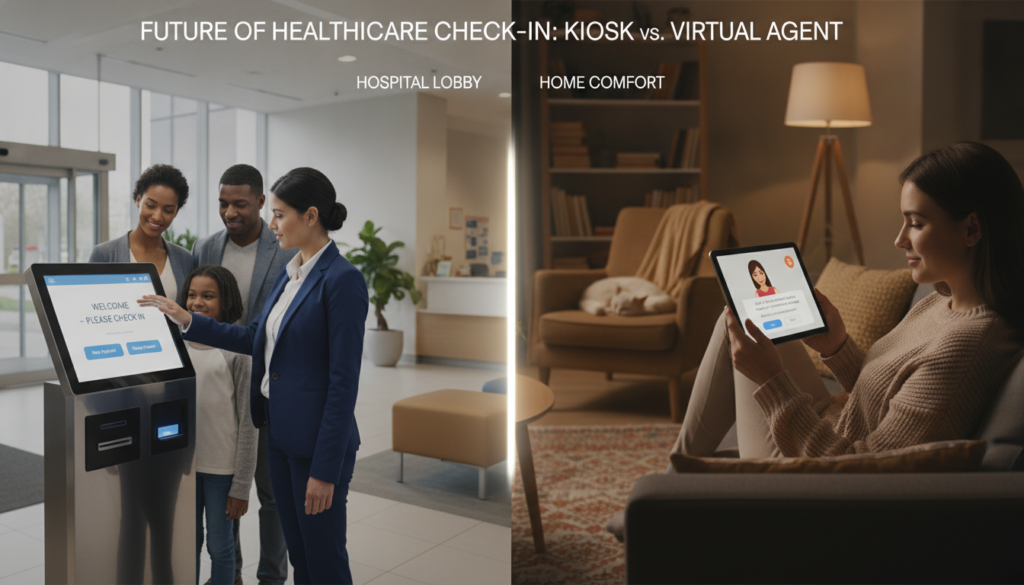
Why the Check-In Experience Shapes the Entire Patient Visit
Research in patient experience consistently shows that the beginning and end of a healthcare visit disproportionately shape a patient’s overall satisfaction rating. The check-in experience — the first two to four minutes of every appointment — sets the emotional tone for everything that follows. A frustrated, rushed, or disorganised check-in experience leaves patients primed to notice every subsequent imperfection. A smooth, friendly, efficient check-in does the opposite: it creates goodwill that buffers patients against minor frustrations later in the visit.
The problem is that the traditional physical front desk is structurally incapable of delivering a consistently excellent check-in experience. A single receptionist simultaneously answering phones, greeting walk-in patients, verifying insurance, processing payments, and managing the waiting room queue is guaranteed to deliver inconsistent service quality — particularly during peak morning hours when the demand on the front desk spikes to a level no individual can manage gracefully.
- Practices using virtual check-in report average patient satisfaction improvement of 18–24 percentage points
- Average check-in time reduced from 8–12 minutes to under 2 minutes
- Insurance verification errors reduced by over 90% when checked in real time before visit
- Front desk overhead reduced by 40–60% on average within 90 days of implementation
How Virtual Check-In Actually Works in Practice
Virtual check-in replaces the physical front desk agent with a dedicated, bilingual virtual agent who manages the complete patient arrival process remotely. The patient either encounters the agent via a tablet at the clinic entrance — where the agent appears on screen to greet them — or receives a phone or video call from the agent as they arrive in the parking area. The entire interaction typically takes ninety seconds to three minutes.
During that interaction, the agent verifies the patient’s identity, confirms insurance coverage against a real-time eligibility check already completed the previous day, reviews any outstanding intake forms, collects any copay or outstanding balance via the card on file, checks the patient into the EHR, and notifies clinical staff that the patient is ready. Nothing is missed. Nothing is rushed. And the agent is never simultaneously managing three other things, because their exclusive function is managing check-in.
The Pre-Visit Workflow: Where Virtual Check-In Delivers the Most Value
The highest-value element of a well-designed virtual check-in programme is the pre-visit workflow — the work that happens before the patient ever arrives. A TMS virtual check-in agent working a forty-patient day will have verified insurance for all forty patients the previous afternoon, sent appointment reminders to each patient forty-eight and two hours before their appointment, collected outstanding intake forms electronically from patients who had not completed them, and identified any coverage issues that require resolution before the visit — giving the clinical team a full day’s notice rather than discovering the problem at the desk while the patient is standing in the waiting room.
This pre-visit work transforms the check-in moment itself. When insurance is already verified, forms are already complete, and the patient has already been reminded and confirmed, the check-in interaction becomes a brief, pleasant confirmation rather than an anxious scramble to gather missing information. That is the moment patients remember when they rate your practice on Google — and it is the moment most practices are currently failing to optimise.
The Business Case: Cost Reduction and Revenue Recovery Simultaneously
Virtual check-in delivers its return on investment through two parallel mechanisms: cost reduction and revenue recovery. On the cost side, replacing or supplementing a $45,000–$60,000 in-house receptionist with a dedicated virtual check-in agent typically reduces front desk staffing costs by 40–60% while delivering higher and more consistent service quality. On the revenue side, the real-time insurance verification eliminates coverage-related claim denials, and the point-of-service copay collection dramatically improves patient responsibility collection rates — which, for the average primary care practice, represent 20–30% of total collectible revenue.
Most TMS clients recover the full annual cost of their virtual check-in programme within the first ninety days through improved patient responsibility collections alone — before accounting for the staffing cost savings or the downstream revenue cycle improvements from eliminating verification-related claim denials. The patient satisfaction improvement is, in that context, essentially free.