
Did you know that the average healthcare practice loses between 15% and 25% of collectible revenue every year? For a practice processing $2 million annually, that’s up to $500,000 lost. This is due to preventable administrative issues.
Many healthcare professionals mix up these terms. But they’re not the same. Knowing what is RCM and how it differs from claims processing is key for your practice’s financial health.
Think of it like this: one is a single task, the other is a whole financial system. Your billing team deals with claim submissions and payments. RCM, on the other hand, covers everything from patient scheduling to final payment collection.
This difference is important. Practices focusing only on claims submission miss out on big opportunities. Revenue leaks occur at many points in the patient journey. Using denial management and RCM strategies can bring in thousands of dollars each month.
In this guide, you’ll see how these two concepts work together. You’ll learn which processes belong to each category. And why this knowledge is vital for your practice’s success.
Key Takeaways
- Healthcare practices lose 15-25% of collectible revenue annually due to RCM failures and administrative gaps
- Medical billing is a part of the RCM framework, not a standalone solution
- RCM covers the whole patient financial journey from scheduling to final payment collection
- Practices with clean claim rates above 97% collect 22% more revenue per patient encounter
- Understanding the difference between billing and RCM helps find revenue leak points across operations
- Comprehensive RCM strategies address issues at multiple touchpoints, not just claim submission
- Effective denial management within 72 hours significantly improves revenue recovery outcomes
Understanding Medical Billing
Every healthcare transaction needs a clear payment plan. That’s what medical billing does. It keeps your practice running smoothly and follows insurance rules. When you understand medical billing, you see how it connects your care with payment.
Your billing team turns complex medical work into codes that insurance knows. They need precision, attention to detail, and knowledge of insurance rules. Without good billing, even top doctors can’t keep their practices open.
What Medical Billing Actually Means
Medical billing is the systematic process of sending claims to insurance companies. Your team turns patient notes into codes using CPT and ICD systems. These codes tell payers what services you gave and why they were needed.
The process starts when a patient gets care and ends when you get paid. It involves you, the patient, their insurance, and sometimes more. Your team must meet each payer’s needs and show what care was given.
Think of medical billing as a special language. It turns medical notes into financial talks. Your team uses codes that insurance needs for processing. Getting this right is key because small mistakes can cause delays or denials.
Why Medical Billing Matters to Your Practice
Your practice’s money flow depends on good billing. Smooth billing means you get paid on time. This keeps your cash flow steady, covering costs and salaries.
Without good billing, even great care can lead to financial trouble and closure. Billing also helps patients understand costs and benefits. This clear talk builds trust and helps collect payments.
| Impact Area | Direct Benefits | Consequences of Poor Billing |
|---|---|---|
| Cash Flow Management | Consistent revenue stream, predictable income patterns, ability to plan investments | Irregular income, inability to meet payroll, delayed equipment purchases |
| Patient Relationships | Clear communication about costs, reduced billing disputes, increased trust | Patient confusion, complaints about surprise bills, damaged reputation |
| Compliance and Legal Protection | Accurate documentation, reduced audit risk, proper coding standards maintained | Regulatory violations, possible fraud allegations, costly audits and penalties |
| Operational Efficiency | Streamlined workflows, reduced claim denials, faster payment cycles | Administrative bottlenecks, high denial rates, staff frustration and burnout |
Good billing also keeps your practice safe from legal trouble. It follows strict rules and codes. Mistakes or wrong codes can lead to big problems.
Core Steps in the Medical Billing Workflow
Your billing process starts when a patient books an appointment. It involves many steps to ensure claims are right the first time. Knowing these steps helps find and fix problems in billing.
The workflow has critical checkpoints for checking information and catching errors. Your team checks patient details, insurance, and if services need approval before care. After care, they enter codes for billing.
Here are the key steps in your medical billing workflow:
- Charge Entry: Your team reviews notes and enters codes into your system
- Claim Creation: Your software makes claim forms with all needed data
- Claim Scrubbing: Your team checks claims for errors before sending them
- Electronic Submission: Clean claims go to insurance companies through clearinghouses
- Payment Posting: Payments are applied to patient accounts, handling any issues
Each step needs meticulous attention to rules and codes. Your team must keep up with changes in rules and codes. This is why many practices use special billing staff or services.
Following up on claims is just as important as sending them. When claims are denied or not fully paid, your team must fix issues and resubmit. This effort is key to getting fair payment for your care.
Overview of Revenue Cycle Management
Understanding RCM means looking at more than just billing. It’s about the whole financial journey of each patient visit. RCM is a complete approach that connects every financial touchpoint in your healthcare organization. It’s different from billing, which only focuses on one part.
Your practice’s success depends on managing the complex web of financial processes. RCM ties these processes together into a single system. This ensures no revenue is lost and keeps your cash flow strong.
What Revenue Cycle Management Means for Your Practice
RCM is the financial process for tracking patient care from start to finish. It coordinates administrative and clinical functions to manage patient service revenue well. Your organization benefits by having a clear path for every financial transaction.
The main goal of RCM is to improve your revenue and speed up payment. Unlike billing, RCM looks at the whole patient financial experience. This includes everything before, during, and after billing.
Your practice uses RCM for better coordination between care and finance. This ensures accurate charges, quick claims, and efficient payments. RCM turns financial operations from reactive to proactive.
Essential Building Blocks of RCM
RCM has many parts that work together for your financial health. Each part is key to capturing and collecting all earned revenue. Knowing these parts helps you see where to improve your finances.
Patient access is the start of RCM. It gets accurate demographic and insurance info from the beginning. This part includes scheduling and insurance checks that help claims process smoothly.
The charge capture and coding part makes sure all services are documented and can be billed. Your coding team uses the right codes for services. Accurate coding affects your payments and follows payer rules.
Claims management handles submitting, tracking, and following up on claims. It’s about getting payments on time. Good claims management means faster revenue for your practice.
Other RCM parts include:
- Payment posting – Accurately records all payments and adjustments
- Denial management – Deals with claim denials and appeals
- Patient collections – Manages patient payments through statements and plans
- Reporting and analytics – Uses data to improve performance
| RCM Component | Primary Function | Impact on Revenue | Key Performance Metric |
|---|---|---|---|
| Patient Access | Verify insurance and collect accurate information | Prevents claim denials and delays | Insurance verification rate |
| Charge Capture | Document all billable services provided | Ensures complete revenue capture | Charge capture rate |
| Claims Management | Submit and track insurance claims | Accelerates payment collection | Clean claim rate |
| Denial Management | Resolve and prevent claim rejections | Recovers lost revenue | Denial rate percentage |
| Patient Collections | Collect patient financial responsibility | Secures out-of-pocket payments | Patient collection rate |
Why RCM Matters for Healthcare Financial Health
RCM is key in healthcare finance today. Reimbursement models are complex, and your organization faces many challenges. Good RCM strategies help you manage these issues well.
RCM is better than billing because it’s a complete system. It reduces claim denials by 20-30% by preventing errors and verifying info well. This means more cash flow and less work for your billing team.
With RCM, payments come in faster. This means you get money sooner. You can then use this money for better equipment, staff, and services.
Patient satisfaction improves with clear financial talks and easy payment options. Patients like knowing what they owe and can pay easily. This makes them happier and more likely to stay with you.
Your healthcare organization’s financial health depends on RCM. It helps you get every dollar you deserve while keeping costs low. With all RCM parts working well, your bottom line gets stronger, helping you care for patients better.
Key Differences Between Medical Billing and RCM
Your practice’s financial success depends on knowing the difference between medical billing and RCM. These terms are often mixed up, but they are distinctly different approaches to managing your healthcare revenue. The RCM vs billing debate is not about picking one over the other. It’s about seeing how each part helps your financial health.
Medical billing is a specialized part of your revenue operations. Revenue cycle management covers the whole financial journey from when a patient books an appointment to when they pay. Knowing these differences helps you use your resources well and build strong financial plans.
Scope of Services
Medical billing focuses on transaction-based activities after patient care. Your billing team turns clinical notes into billable claims, sends them to payers, and collects payments. This includes entering charges, making claims, posting payments, and billing patients.
Revenue cycle management goes beyond these steps. It starts with scheduling and registration, goes through care delivery, and includes financial counseling and reporting. Your RCM strategy looks at every point where revenue comes in or goes out.
Medical billing has three to five core processes. Revenue cycle management has twelve to fifteen stages. Your billing team might handle 200 claims a day. Your RCM team watches thousands of patient accounts at once.
Goals and Objectives
Medical billing aims for tactical goals like claim accuracy and quick payments. Your billing team wants high clean claim rates, fewer denials, and faster payments. Success is measured by first-pass resolution, days in accounts receivable, and collection rates.
Revenue cycle management has strategic and wide-ranging goals. It aims to improve financial performance, cut costs, boost patient satisfaction, and follow rules. These goals need teamwork and long-term planning.
Consider these different goals:
- Medical Billing: Send 98% of claims within 24 hours of service
- RCM: Cut total cost-to-collect by 15% and improve patient payments
- Medical Billing: Get 95% clean claim rate on first try
- RCM: Increase point-of-service collections by 30% with better financial counseling
- Medical Billing: Fix denied claims in 10 business days
- RCM: Use predictive analytics to stop denials before they happen
Your billing goals focus on immediate needs. RCM goals aim for big improvements. This shows how you measure success and where to improve.
Role in Financial Health
Medical billing is a reactive, focused-on-execution part of your revenue system. When your billing team finds a problem, they fix it without looking at the big picture. They handle denials, errors, and payments as they come up.
Revenue cycle management is a proactive, data-driven strategy that keeps an eye on your finances all the time. It spots trends, predicts problems, and prevents them. This way, you make smart decisions to improve your whole revenue operation.
The financial health impact is big between these two approaches. Medical billing affects your cash flow and how fast you collect money. Revenue cycle management improves your efficiency, keeps patients, follows rules, and helps your finances in the long run.
| Aspect | Medical Billing | Revenue Cycle Management |
|---|---|---|
| Primary Focus | Claim submission and payment collection | End-to-end revenue optimization across patient journey |
| Operational Approach | Reactive and transaction-based | Proactive and analytics-driven |
| Key Performance Indicators | Clean claim rate, days in AR, collection percentage | Net collection rate, cost-to-collect, patient satisfaction scores |
| Departmental Involvement | Primarily billing and coding staff | Registration, clinical, billing, finance, and patient services teams |
| Technology Requirements | Billing software and clearinghouse connections | Integrated platforms with EHR, analytics, and patient engagement tools |
Your billing keeps revenue flowing with accurate claims. Your RCM strategy makes this flow keep getting better through better systems. Both are key, but they work at different levels in your organization.
Knowing the difference between RCM and billing helps you decide where to spend on training, tech, and process improvements. Small practices might focus on great billing. Larger ones need a full RCM strategy to handle complexity and boost finances.
The Medical Billing Process Explained
Every dollar your practice collects starts with a well-executed billing process. It moves from patient arrival to final payment. The medical billing workflow has stages that need precision and attention to detail.
Your billing team handles many touchpoints, from initial patient contact to reconciling payments. Understanding each phase helps you spot and prevent errors. This ensures your practice gets the right reimbursement for services.
Collecting Essential Patient Information
Patient registration is the foundation of your billing operation. Your front desk staff collects demographic information like name, date of birth, and address. This information must be accurate and complete to avoid errors.
You also gather insurance details, including the insurance company name and policy number. Many practices use electronic patient intake forms to reduce errors. These digital solutions let patients enter their own information before their appointment.
Your staff should verify patient identification and insurance cards at every visit. Policy changes can happen without notice. Collecting copayments at registration improves cash flow and reduces billing work.

Confirming Coverage and Patient Responsibility
Insurance verification protects your practice from claim denials and unexpected patient balances. Your team contacts the insurance carrier to confirm coverage and what services are covered. This step should happen before services are rendered.
During verification, you’ll find out about the patient’s deductible status and copayment amounts. Understanding these financial obligations upfront helps communicate costs clearly. Many practices struggle with collections because they fail to explain costs before treatment.
You can use real-time eligibility verification tools to streamline this process. These automated solutions provide instant responses about coverage details. But, you should document verification in the patient’s account and obtain authorization numbers when needed.
Creating and Transmitting Claims
Claims submission turns medical services into standardized codes that payers recognize. Your team assigns CPT codes for procedures, ICD-10 codes for diagnoses, and HCPCS codes for supplies. These codes must match the patient’s medical record.
Once coding is done, your team generates the claim. The claim includes patient demographics, insurance details, and service dates. Modern billing software performs electronic claim scrubbing to find errors before sending.
Most practices submit claims electronically through clearinghouses. Electronic submission is faster and more efficient than paper claims. You’ll get acknowledgment reports confirming that payers received your claims, though acceptance doesn’t guarantee payment.
The billing process gets complex with coordination of benefits scenarios or secondary insurance. Your team must understand payer hierarchies and billing sequences. Submitting claims to the wrong payer first creates delays and extra work.
Recording Payments and Managing Balances
Payment posting completes the billing cycle by recording all payments and adjustments. When payers send reimbursement, they include an Explanation of Benefits (EOB) or Electronic Remittance Advice (ERA). Your billing staff must reconcile these documents against the original claim.
You’ll post the insurance payment amount to the correct patient account and procedure code. Contractual adjustments write off the difference between your billed charges and the allowed amount. Your team then calculates the remaining patient responsibility by adding copayments, coinsurance, and deductibles that the insurance didn’t cover.
Accurate payment posting provides the data you need for financial reporting and performance analysis. When your team posts payments incorrectly, your accounts receivable reports become unreliable. This makes it hard to identify which claims need follow-up or which patients owe balances.
Your practice should have clear procedures for handling partial payments, denials, and adjustments. Some payments require additional action, such as appealing a denial or sending a statement to the patient. A well-organized payment posting system ensures nothing falls through the cracks.
| Billing Stage | Primary Activities | Key Data Elements | Common Challenges |
|---|---|---|---|
| Patient Registration | Collect demographics and insurance information | Name, DOB, address, policy numbers | Incomplete or inaccurate information entry |
| Insurance Verification | Confirm coverage and authorization requirements | Eligibility status, benefits, patient responsibility | Last-minute coverage changes or lapses |
| Claims Submission | Code services and transmit claims to payers | CPT codes, ICD-10 codes, service dates | Coding errors and documentation mismatches |
| Payment Posting | Record payments and calculate patient balances | Payment amounts, adjustments, EOB details | Reconciliation discrepancies and posting delays |
Your billing process needs constant monitoring and refinement to stay efficient. Each stage offers chances for improvement through staff training, technology adoption, and process standardization. Optimizing these four phases reduces claim denials, speeds up reimbursement, and boosts your practice’s financial performance.
The Revenue Cycle Management Process Explained
The revenue cycle management process covers all financial steps in your practice. It makes a smooth system that boosts revenue at every step. Knowing what RCM is means seeing it as more than billing. It’s a full plan that starts before patients arrive and goes until every dollar is collected.
Each part of the RCM process links to the next, making a loop of checking and getting better. If one part doesn’t work well, it affects the whole cycle. Seeing these stages as connected parts of a single system helps your practice the most.
Patient Access and Scheduling
Your revenue cycle starts when a patient calls to schedule an appointment. This early stage is key for what comes next. Staff check patient info, confirm insurance, and check for needed approvals before services start.
Good patient access is more than just booking times. Your team should talk about costs and what patients owe. This clear talk helps avoid delays and makes patients happier.
Before services, your team must send out prior authorization requests. They should also get copays or deposits upfront. These steps help avoid many problems later on.
Charge Capture and Coding
Charge capture makes sure every service your practice offers is documented and coded right. This step stops lost revenue from missed charges or wrong info. Your clinical team must write down all services right away for accuracy.
Medical coders then turn these services into codes that payers understand. They use Current Procedural Terminology (CPT) for procedures and International Classification of Diseases (ICD) for diagnoses. How well they code affects how much you get paid.
Today, technology helps a lot with charge capture. EHR systems with charge capture modules cut down on mistakes. Regular checks help find and fix any missed charges or coding errors that cost you money.
Claims Management and Follow-Up
Claims management is more than just sending bills to insurance. Your billing team must keep track of each claim, find delays, and fix problems fast. This keeps claims from getting lost and helps avoid late filing problems.
Good claims management means knowing how payers act. Some payers often delay certain claims or ask for specific info. Your team can make the process smoother by knowing these patterns and sending the right info early.
Following up on unpaid claims needs to be regular and thorough. Your team should have clear steps for when to follow up, what to send, and how to deal with tough cases. Keeping track of how claims are doing helps find and fix problems in your cycle.
| RCM Phase | Primary Functions | Key Performance Indicators | Revenue Impact |
|---|---|---|---|
| Patient Access | Eligibility verification, prior authorization, financial counseling | Authorization approval rate, point-of-service collection percentage | Prevents denials, improves upfront collections |
| Charge Capture | Service documentation, medical coding, charge entry | Charge lag days, coding accuracy rate, charge capture percentage | Eliminates revenue leakage, ensures complete billing |
| Claims Management | Claims submission, status tracking, payer follow-up | Clean claim rate, days in accounts receivable, collection rate | Accelerates payment, reduces aging accounts |
| Denials Management | Denial analysis, appeals processing, prevention strategies | Denial rate, overturn rate, denial resolution time | Recovers lost revenue, prevents future denials |
Denials Management
Denials management is key in the RCM process. When payers deny claims, you lose money unless you have good systems to appeal and win back those funds. A comprehensive denials management program finds out why denials happen and fixes the problems.
Your team should sort denials by reason to find patterns. Common reasons include missing info, coding mistakes, not being medically necessary, and filing too late. Each reason needs a different fix.
Good denials management has both quick fixes and long-term solutions. You should appeal wrong denials fast to get your money back. At the same time, work on the main causes by improving early steps, coder training, or documentation.
The value of knowing RCM is clear when you see how denials management ties back to earlier steps. A denial about missing prior authorization shows a patient access issue. Coding errors lead to denials, showing charge capture problems. This cycle lets your practice keep getting better at every step.
Your revenue cycle works best when all four steps work together. Regular team meetings help find ways to improve together. Using technology makes sure data moves smoothly between steps, reducing mistakes. Seeing RCM as a continuous cycle opens up chances for improvement that old billing ways miss.
Software Tools Used in Medical Billing
Medical billing software offers many tools to make billing easier and faster. These tools help practices stay financially stable and cut down on paperwork. Knowing what’s out there helps you choose the right tech for your needs.
With healthcare billing explained through modern tech, tasks become automated. The right tools boost efficiency, which helps your bottom line. Your choice of software affects how fast you get paid and how well your team handles billing.
Popular Billing Technology Platforms
Many medical billing software solutions lead the industry. Kareo is great for small to medium-sized practices. It’s easy to use and has billing and practice management features.
AdvancedMD is for bigger practices and those with many locations. It handles lots of claims well and has detailed reports. These reports help find ways to make more money.
CollaborateMD focuses on billing without extra features. It’s good for practices that use other systems for scheduling or records. It makes submitting claims fast and simple.
Integrated practice management systems are another option. They combine billing with scheduling, records, and patient communication. They cost more upfront but solve data transfer problems.
Essential Capabilities for Your Practice
Choosing medical billing software means looking at key features. Electronic claim submission should work with all major payers and allow batch processing. This makes getting paid faster.
Real-time eligibility verification checks patient coverage before appointments. It connects to payer databases for instant info. This avoids treating patients without coverage.
Automated claim scrubbing finds errors before claims are sent. It checks for missing info and coding mistakes. This boosts your claim acceptance rate.
Your software should have customizable reports. Look for dashboards that show:
- Days in accounts receivable by payer and service type
- Collection rates compared to industry benchmarks
- Denial rates with categorization by reason code
- Provider productivity measured by relative value units
- Outstanding balance aging analysis
Patient statement generation makes it easy for patients to pay. Modern solutions create professional statements with payment links. This improves patient payment rates.
Payment processing integration lets you take credit card payments directly. This means staff can post payments right away. It cuts down on reconciliation time and gives patients more payment options.
Transformative Advantages of Digital Solutions
Automation in medical billing software brings big benefits. Error reduction is a key advantage, as it removes transcription mistakes. This leads to higher claim acceptance rates.
Automation makes claims submission fast, which means faster payments. This improves your practice’s cash flow. You get paid weeks sooner than with manual billing.
Collection rate improvements are common with good billing software. Faster submission, fewer errors, and better follow-up on unpaid claims increase revenue. Your practice grows without needing more patients.
Good billing software gives clear insights into your billing performance. Real-time dashboards show claim status. This helps identify problems and improve management decisions.
Automation lets staff focus on complex issues, not routine tasks. They can work on denials, underpayments, and patient payments. This makes your billing team more valuable.
While medical billing software boosts efficiency, it’s not as wide-ranging as revenue cycle management platforms. Knowing this helps set the right expectations and plan for future growth.
Software Tools for Revenue Cycle Management
RCM vs billing shows a big difference in software. Billing software mainly deals with claims and payments. But, RCM software manages everything from scheduling to final payment.
RCM software is like a command center for your finances. It doesn’t just process payments. It optimizes every touchpoint in the patient’s financial journey. This is a big change from just solving problems to making money proactively.
Comprehensive Platforms That Transform Your Operations
Looking at RCM software, you’ll see top platforms that change finance management. Epic Revenue Cycle connects clinical and financial workflows. It gives you real-time views of your revenue cycle.
Cerner RevElate is great if you use Cerner’s EHR. It automates claim scrubbing and finds denials early. This reduces manual work and boosts accuracy.
athenaCollector offers a cloud-based RCM. It’s easy to use without needing a lot of IT. It learns from millions of claims to improve your cycle.
NextGen Enterprise grows with your practice. It’s scalable for small clinics or big hospitals. It has templates and automation to reduce staff work.
The future of healthcare finance needs technology that connects all data points. It turns transactions into strategic insights.
Seamless Connections Across Your Healthcare Ecosystem
Integration is key for RCM software. It connects systems for a unified network. Electronic health record integration makes coding and billing smooth.
Your practice management system connects scheduling with finances. This cuts down on errors and saves staff time. They can focus on revenue more.
Patient portal integration lets patients manage their bills online. They can see statements, make payments, and ask questions. This makes patients happy and speeds up payments.
Financial system integration connects your RCM with other software. You get a full financial view without reconciling data. This makes month-end closing faster and more accurate.
Intelligence That Drives Strategic Decisions
Analytics and reporting turn RCM software into a strategic tool. Key performance indicator dashboards show important metrics in real-time. You can see how your cycle is doing without waiting for reports.
Predictive analytics spot revenue risks early. It analyzes data to find claims at risk and patients who might struggle with payments. This foresight lets you act before problems hit your bottom line.
Benchmarking compares your performance with others. You see where you’re doing well and where you can improve. This helps set goals and justify investments.
Drill-down capabilities let you dive into details. If your denial rate goes up, you can find out why. This helps you fix problems where they matter most.
Custom reporting tools let you ask specific questions. You can create reports that give you unique insights. These reports are great for planning and making decisions.
Automation in analytics saves a lot of time. Scheduled reports send important info automatically. Alert systems notify you of issues right away, so you can act fast.
Challenges in Medical Billing
Medical billing is not always easy. Mistakes and complex rules can slow down payments. Knowing these challenges helps protect your money.
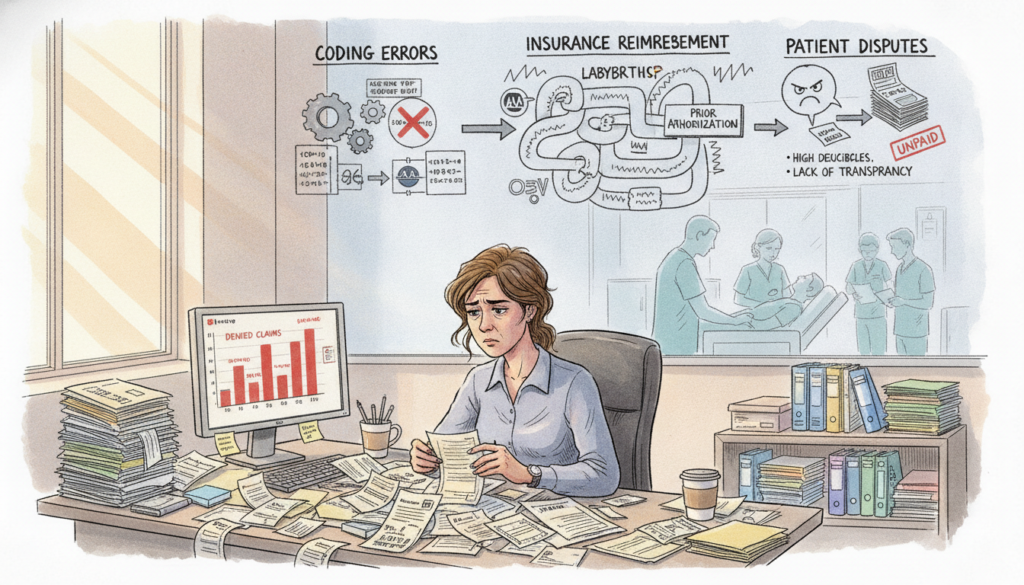
Small errors can cause big problems in medical billing. The system is complex, making it easy for mistakes to happen. This can hurt your money flow.
Frequent Mistakes That Disrupt Your Revenue
Your team makes common errors in billing. These mistakes can slow down getting paid. By knowing these mistakes, you can fix them before they happen.
The most common errors include:
- Incorrect patient information like wrong names or dates of birth, causing claims to be rejected
- Missing or invalid insurance details like expired policy numbers or wrong group identifiers
- Coding errors like wrong codes or missing information
- Duplicate billing where the same service is billed twice
- Failure to obtain necessary authorizations for procedures needing approval
These mistakes cost time and money. Your team must fix them, which delays payment. This can take weeks or months.
Financial Consequences of Rejected Claims
Denied claims hurt more than just your cash flow. They affect your whole revenue cycle. Knowing how they impact you helps you prevent them.
Fixing one denied claim costs between $25 and $117. This includes staff time and other costs. Many claims add up to a big financial burden.
“Denied claims are a big problem for healthcare, costing billions in rework and lost money.”
Denied claims also harm your relationship with payers. This can lead to more checks on your claims. Patients get upset when billing issues cause delays in their care.
| Denial Impact Area | Average Cost | Time Delay | Secondary Effect |
|---|---|---|---|
| Claim Rework | $25-$117 per claim | 15-30 days | Reduced staff productivity |
| Revenue Delay | Variable by claim value | 30-90 days | Cash flow disruption |
| Appeals Process | $50-$200 per appeal | 45-120 days | Administrative burden increase |
| Patient Relations | Indirect costs | Ongoing | Trust and satisfaction decline |
Keeping Your Team Current and Compliant
Your team must keep up with changing rules. Coding and payer policies change often. They need constant learning and updates.
Training programs help your team stay accurate. Regular updates on coding and rules protect your practice. Without training, your accuracy will drop.
Systems track your team’s performance. They find areas for more training. This helps fix knowledge gaps before they become big problems.
Keeping up with rules gets harder as they get more complex. Your practice must weigh the cost of training against the cost of mistakes. Training is cheaper than dealing with big errors.
Challenges in Revenue Cycle Management
Setting up effective RCM systems comes with its own set of challenges. These challenges affect your whole organization, not just billing. Knowing what RCM entails helps you prepare for the complexity ahead.
These challenges are more than just claim errors or payment delays. Your organization must tackle systemic issues that affect finances, compliance, and efficiency. Problems in one area can spread to others, affecting your revenue cycle.
To overcome RCM challenges, you need comprehensive planning, dedicated resources, and ongoing commitment. Your team must develop strategies that address immediate problems and prepare for future changes in healthcare.
Complexity of Revenue Streams
Today’s healthcare organizations face a complex array of revenue streams. You manage multiple payment models, each with its own rules and requirements. This demands specialized knowledge and systems.
This complexity makes management a big challenge. You must track and optimize performance across different payment models. Each model requires different approaches to charge capture, coding, and follow-up.
| Payment Model | Documentation Requirements | Reimbursement Timeline | Management Complexity |
|---|---|---|---|
| Fee-for-Service | Detailed procedure documentation and medical necessity justification | 30-60 days after claim submission | Moderate – established workflows and clear per-service rates |
| Value-Based Care | Quality metrics, patient outcomes, and care coordination records | Quarterly or annual reconciliation periods | High – requires continuous performance monitoring and analytics |
| Bundled Payments | Episode-of-care tracking across multiple providers and settings | 90-180 days post-episode completion | Very High – demands coordination among multiple entities |
| Capitation | Member attribution, utilization tracking, and preventive care documentation | Monthly predetermined payments with annual adjustments | High – requires population health management infrastructure |
The shift to value-based reimbursement models complicates RCM. You must capture and report quality measures and patient data. This requires advanced analytics that connect clinical and financial data.
Managing patient responsibility is another challenge. With high-deductible plans, you collect more from patients. This needs different collection strategies and financial counseling.
Evolving Regulations
Your RCM operations must adapt to changing regulations. These affect reimbursement, reporting, and compliance. Regulations evolve regularly, creating ongoing challenges.
Recent changes have impacted RCM operations. Price transparency requirements now affect how you communicate costs. This requires new processes and technology.
Staying current with coding requirements is a challenge. The transition to ICD-11 codes and updates to CPT codes require continuous education. Your coding staff must stay up-to-date across multiple systems.
Payer-specific policy changes add complexity. Each insurance company updates policies and requirements differently. You must monitor these changes and update your systems to prevent denials.
- No Surprises Act compliance requiring good faith estimates and balance billing protections
- Information blocking regulations under the 21st Century Cures Act affecting data sharing
- Medicare payment rule updates that change reimbursement formulas annually
- State-specific billing regulations that vary significantly across jurisdictions
- Quality reporting program requirements tied to payment adjustments
Compliance monitoring in RCM goes beyond following rules. You need systems that identify compliance issues and provide real-time guidance. This requires significant investment and expertise.
Technology Integration Challenges
Connecting different systems for RCM is a big challenge. Your systems may not work together, causing data inconsistencies and workflow disruptions.
Integration difficulties start with data compatibility issues. Systems store information differently, leading to duplicate records, missing information, or processing errors.
Workflow disruptions during integration can hurt your revenue cycle performance. Staff must learn new systems while managing daily operations. This leads to productivity declines and increased errors.
Vendor compatibility is another challenge. You may choose best-of-breed systems that don’t communicate well. Interface development requires technical expertise and ongoing maintenance.
- Authentication and security protocols that differ across systems, complicating single sign-on implementations
- Real-time data synchronization issues causing delays in information availability across platforms
- Custom field mapping requirements that demand extensive configuration and testing
- Version update complications when one system upgrade breaks existing interfaces
- Limited API functionality restricting the depth of integration possible between systems
Successful technology integration requires more than initial costs. You need dedicated technical staff, ongoing vendor support contracts, and continuous optimization efforts. These long-term commitments often surprise organizations.
Understanding RCM from a technology perspective shows that it’s more than buying software. You need organizational commitment, realistic timelines, and change management strategies. Without this, technology investments may not deliver expected returns.
The Importance of Accurate Coding in Both Fields
When comparing RCM vs billing, one key thing is the same: accurate medical coding is vital for getting paid. Coding is like a special language that turns your medical services into codes that payers understand. Without correct coding, even the best billing or RCM systems can’t fully show the value of your care.
Your coding team is key to your practice’s money health. They turn doctor notes into codes that tell payers about your patients’ health. This job needs special skills, training, and detail to make sure every claim is right.
How Coding Drives Reimbursement
Coding decides if your claims get paid, how much, and if they’re covered. You use ICD-10-CM for diagnoses, CPT for procedures, and HCPCS for services and supplies. Each code must match the doctor’s notes and meet payer rules.
Your money depends on picking the right codes and putting them in the right order. The main diagnosis code must show why the patient came in. Other codes add details like complications or other health issues. Wrong order can lead to denied claims or less money, even if the codes are right.
Today, coding is more than just getting paid. It affects quality scores, risk scores, and benchmarking data that change how much you get paid later. In value-based care, coding shows how complex your patients are and the quality of care you give.
Good coding starts with clear doctor notes. Every code must have strong support in the patient’s file. Payers use computers to check if claims match the records. If not, they might delay payment and make your team work harder.
The virtual check-in patient experience makes coding even more important. Digital visits need the same careful coding as in-person visits. Your team must keep up with new rules and codes for telehealth and other digital services.
Risks of Coding Errors
Bad coding can hurt your money and reputation a lot. You might get less money or face big fines. It’s important to avoid both under-coding and over-coding.
Under-coding means you miss out on money. Using lower codes than the notes suggest can lower your case-mix index. This makes your patients seem less sick, which can hurt your future money and quality scores.
Over-coding is even riskier. It can lead to fines, refunds, and even being kicked out of healthcare programs. The Office of Inspector General watches for this closely.
The bad effects of coding mistakes include:
- Financial penalties like denied claims or big refunds
- Reputational damage that hurts your relationships with payers
- Legal exposure for submitting wrong codes
- Administrative burden from appeals and audits
- Lost revenue from delayed payments
Even mistakes made by accident can hurt you. Payers don’t care if it was on purpose or not. So, training your coders well and checking their work is key for both billing and RCM.
| Coding Scenario | Financial Impact | Compliance Risk | Operational Effect |
|---|---|---|---|
| Accurate coding with proper documentation | Optimized reimbursement matching services provided | Minimal audit risk and compliance confidence | Clean claims and efficient payment cycles |
| Under-coding conservative approach | Revenue loss of 10-30% on affected claims | Low compliance risk but missed opportunities | Reduced case-mix data and quality metrics |
| Over-coding exceeding documentation | Initial overpayment followed by repayment demands | High audit probability and fraud investigation | Significant administrative burden and reputational harm |
| Inconsistent coding without quality controls | Unpredictable revenue and increased denials | Moderate to high risk depending on patterns | Rework requirements and delayed cash flow |
Coding needs constant learning and keeping up with changes. The rules and codes change every year. Your team must keep learning to stay accurate and follow the rules.
Both billing and RCM rely on accurate coding. Billing focuses on each claim, while RCM looks at patterns to find ways to improve. This helps avoid big problems before they start.
Understanding RCM vs billing shows coding is at the heart of both. Investing in accurate coding helps your money and keeps you safe from fines. It’s a smart move for your practice’s future.
Strategies for Improving Medical Billing Efficiency
Smart strategies can make your billing operations efficient. Your billing team affects every dollar that comes into your practice. By improving efficiency, you can make more money.
Healthcare billing works best with a clear plan. You need to know what works, train your team, and use automation. Here are strategies to improve your billing department.
Implementing Proven Billing Best Practices
Your billing starts before you submit a claim. Verifying insurance before every patient visit stops denials and saves time. This can cut up to 30% of claim rejections.
Have clear rules for your team to follow. Submitting claims quickly improves cash flow and reduces errors.
Here are essential best practices for your billing:
- Create standard templates for billing information at the point of care
- Use a system to track claim status and flag unpaid claims after 14 days
- Have efficient workflows for payment posting and reconciliation
- Do weekly scrub sessions to review pending claims and fix issues
- Set up reminders for follow-up on outstanding accounts
Your team needs to understand how their work affects money. When providers know this, they help with billing.
Building a Culture of Continuous Staff Development
Your team’s knowledge affects your money. Invest in regular training to reduce errors and speed up claims. Your staff needs to keep learning to do their best.
Have monthly training on coding updates and payer changes. Real-world examples help your team remember better than lectures. Use denied claims to teach and prevent mistakes.
Here are training ideas:
- Quarterly coding update workshops for your specialty
- Monthly payer policy review meetings
- Weekly denial pattern analysis sessions
- Cross-training programs for flexibility and less bottlenecks
- Support for professional certifications like CPC or CCS
Experienced billers should teach new staff. This keeps knowledge in the team and helps when people leave.
Recognition programs motivate your team. Consider bonuses for accuracy and productivity.
Maximizing Technology for Automated Efficiency
Your billing software has great features you might not use. Automation makes work easier and faster. Check your technology to find what you’re missing.
Real-time eligibility checks save a lot of time. ERA auto-posting cuts down on manual entry errors.
Here’s a table showing key technology features and their benefits:
| Technology Feature | Primary Benefit | Average Time Savings | Error Reduction |
|---|---|---|---|
| Automated Eligibility Verification | Confirms coverage before service | 15-20 minutes per patient | Reduces eligibility denials by 85% |
| Claim Scrubbing Software | Identifies errors before submission | 10 minutes per claim review | Improves clean claim rate by 25% |
| ERA Auto-Posting | Eliminates manual payment entry | 5-7 minutes per remittance | Reduces posting errors by 90% |
| Batch Claim Processing | Submits multiple claims at once | 30-45 minutes daily | Standardizes submission protocols |
| Custom Analytics Dashboards | Shows bottlenecks and trends | 2-3 hours weekly on reporting | Enables proactive problem-solving |
Use reports to track important metrics. Look at days in accounts receivable, first-pass acceptance rates, and cost per claim processed.
Reduce days in accounts receivable by 20-30% with these technology features. Data-driven insights help make better decisions.
Make sure your technology works with your EHR and practice management systems. This reduces errors and saves time.
By using best practices, training, and technology, you can make your billing department better. It becomes a key part of your practice’s success.
Strategies for Enhancing Revenue Cycle Management
Your healthcare organization can do better financially. This is by using specific strategies for RCM. Knowing what RCM is means you see it’s about every part of the cycle.
Streamlining Your Operations
Start by making front-end processes better. Collect payments right when services are given. Also, offer financial advice to patients.
For the middle part, use coding right away and check charge capture often. At the end, use automated denial workflows and analytics to spot issues early.
Tracking Performance Metrics
Keep an eye on important numbers to keep your revenue cycle healthy. Watch days in accounts receivable, clean claim rates, denial rates, and collection costs. Use dashboards to see these numbers in real time.
Have regular meetings to talk about these numbers. This helps you spot trends and act fast if needed.
Building Patient-Centered Approaches
Your patients are important and want easy experiences. Give them clear price info and flexible payment plans. Make payments easy with online and text options.
Send messages about money early and make bills simple. This way, patients understand their bills better.
When you use these strategies, the difference between RCM and billing is clear. Success needs a plan, teamwork, and the right tech. Focus on being efficient and caring for patients to keep your finances strong.