Healthcare data breaches cost over $10.93 million per incident in 2023. Remote work issues are a big part of these problems. If you’re thinking about hiring remote staff for patient info, knowing the rules is key.
Virtual medical assistants do tasks like scheduling and insurance checks. They see the same private patient data as your team. But many places forget to check if these remote workers are certified.
Hiring untrained remote staff can hurt your practice a lot. You could face fines, lose patient trust, and even legal trouble. Healthcare compliance is not just a rule—it’s about keeping patient secrets safe.
This guide will show you how to pick and keep compliant virtual medical assistants. You’ll learn how to spot the right people and avoid big problems.
Key Takeaways
- Healthcare data breaches cost practices millions, making proper staff certification essential for protecting patient privacy
- Remote healthcare workers require the same rigorous compliance standards as in-office employees
- Untrained staff expose your practice to legal penalties, reputation damage, and loss of patient trust
- Proper vetting processes help identify qualified professionals who understand confidentiality requirements
- Ongoing education ensures your remote team stays current with evolving regulatory standards
- Investing in certified professionals protects both patients and your practice’s long-term success
Understanding HIPAA and Its Importance
Before you hire a virtual medical assistant, you must know about HIPAA rules. These rules protect your practice and patients. They are key to keeping your team in line with the law.
The healthcare world has changed a lot. Now, we use digital records and work from home. Your virtual assistant will handle the same sensitive information as on-site staff. So, it’s very important they learn about keeping patient info private.
The Federal Law That Changed Healthcare
HIPAA stands for the Health Insurance Portability and Accountability Act. It was passed in 1996. It sets national standards for protecting patient health info.
This law applies to certain healthcare groups. These include doctors, health plans, and places that handle health info. Your virtual medical assistants are considered business associates. They must follow the same strict rules as your in-house team.
HIPAA isn’t just for doctors and hospitals. It also covers anyone who handles health info for them. This includes your HIPAA compliant VMA, no matter where they are.
Why These Regulations Exist
HIPAA rules do two main things. They help patients keep insurance when they change jobs. They also protect health info in our digital world.
Before HIPAA, there was no standard for keeping patient info safe. These rules created a unified framework that applies nationwide. This gives patients the same protection everywhere they get care.
With new tech, keeping patient info safe is harder. Electronic records, telemedicine, and remote assistants all pose challenges. Knowing why these rules are important helps you see why training your virtual staff is essential.
The Three Pillars of Compliance
HIPAA compliance is based on three main rules. Each rule deals with how your HIPAA compliant VMA handles sensitive data. Knowing these rules helps you see if a candidate is well-trained.
| HIPAA Component | Primary Focus | Key Requirements | VMA Responsibilities |
|---|---|---|---|
| Privacy Rule | Protecting health information use and disclosure | Controls who can access patient data and under what circumstances | Follow minimum necessary standards, obtain authorizations, maintain confidentiality |
| Security Rule | Safeguarding electronic protected health information | Implements technical, administrative, and physical safeguards for digital data | Use secure systems, encrypt communications, implement access controls |
| Breach Notification Rule | Requiring notification of data breaches | Mandates timely reporting when unauthorized access or disclosure occurs | Immediately report suspected breaches, document incidents, follow protocols |
The Privacy Rule sets rules for using and sharing patient info. It gives patients rights over their health info. Your virtual assistant must know these rules to avoid mistakes.
The Security Rule focuses on keeping electronic health info safe. This rule requires using technical, administrative, and physical safeguards to protect data. Your remote team must use encrypted channels and secure devices.
The Breach Notification Rule makes sure there’s accountability for security failures. Healthcare providers must tell patients, the Department of Health and Human Services, and sometimes the media about breaches. Your virtual medical assistant needs to know how to report any security issues right away.
These three rules make up a complete framework for HIPAA compliance. They cover prevention, protection, and how to handle security problems. When looking at training for your virtual staff, make sure all three rules are covered well.
Your hiring process should check if candidates know how these rules apply to their job. A good HIPAA compliant VMA can explain each rule and show how they follow it. This knowledge keeps your practice safe and earns your patients’ trust.
Benefits of HIPAA Training for Virtual Medical Assistants
When you train your virtual medical assistants in HIPAA, you get many benefits. This training helps protect your practice and gives you an edge. It makes your operations better, from talking to patients to keeping your business strong.
Your virtual assistants become key assets, not risks. They learn to follow complex rules and work efficiently. This mix of compliance skills and flexibility helps you stand out in healthcare.
Enhancing Patient Privacy and Security
Your virtual assistants are the first line of defense against data breaches. They learn to spot phishing attacks that target healthcare. This skill is vital as cyber threats get more clever.
They also learn to protect their home offices. Your team discovers how to use encrypted messages and strong passwords. They know how to keep work and personal devices separate and use antivirus software.
Security benefits go beyond individual computers. Your team learns to handle electronic health records safely. They use secure ways to talk about sensitive info.
Healthcare groups with thorough security training for all staff, including virtual assistants, see 58% fewer data breaches. This is compared to those with little training.
Your virtual assistants learn to create strong authentication methods. They use multi-factor authentication and avoid shared passwords. They watch for unusual account activity, adding layers of security.
Building Trust with Patients
Showing you care about HIPAA builds trust with patients. When patients see your team is trained, they feel safer sharing health info. This leads to better medical histories and treatment plans.
Patients might not share all info because of privacy worries. But with your training, they feel more comfortable. This honesty helps your practice more.
This trust makes your practice stand out. Happy patients tell others and write good reviews. Your focus on privacy makes you different from others who don’t care as much.
| Trust Indicator | Practices With Trained VAs | Practices Without VA Training | Impact Difference |
|---|---|---|---|
| Patient Retention Rate | 87% | 72% | +15% |
| Positive Online Reviews | 4.6/5.0 | 3.8/5.0 | +0.8 points |
| Referral Generation | 34 per month | 19 per month | +79% |
| Patient Complaint Rate | 2.1% | 6.8% | -69% |
Your HIPAA standards are part of your marketing. You can proudly say your practice is secure and private. This honesty attracts more patients who check out your practice before visiting.
Reducing Legal Risks
Not following HIPAA can cost a lot. Fines start at $100 per mistake and can go up to $50,000 for serious neglect. The maximum penalty for repeated mistakes is $1.5 million.
Training shows you’re serious about following rules. When auditors check, your training records will help. This is your strongest defense against privacy rule questions.
Breaking HIPAA rules can lead to criminal charges. These can include jail time. Your trained team knows how serious this is, so they follow rules carefully.
Good training also protects you from lawsuits. Patients might sue if their info is leaked. Your training lowers the chance of these problems.
Bad publicity from privacy breaches can hurt more than fines. News spreads fast on social media. Your training keeps your practice’s reputation safe.
Insurance companies give discounts for practices with trained staff. This saves money over time, making your training worth it.
Your trained team can spot and fix problems early. They know when to ask for help from your compliance officer or lawyer. This stops small mistakes from becoming big problems.
Key Topics Covered in HIPAA Training
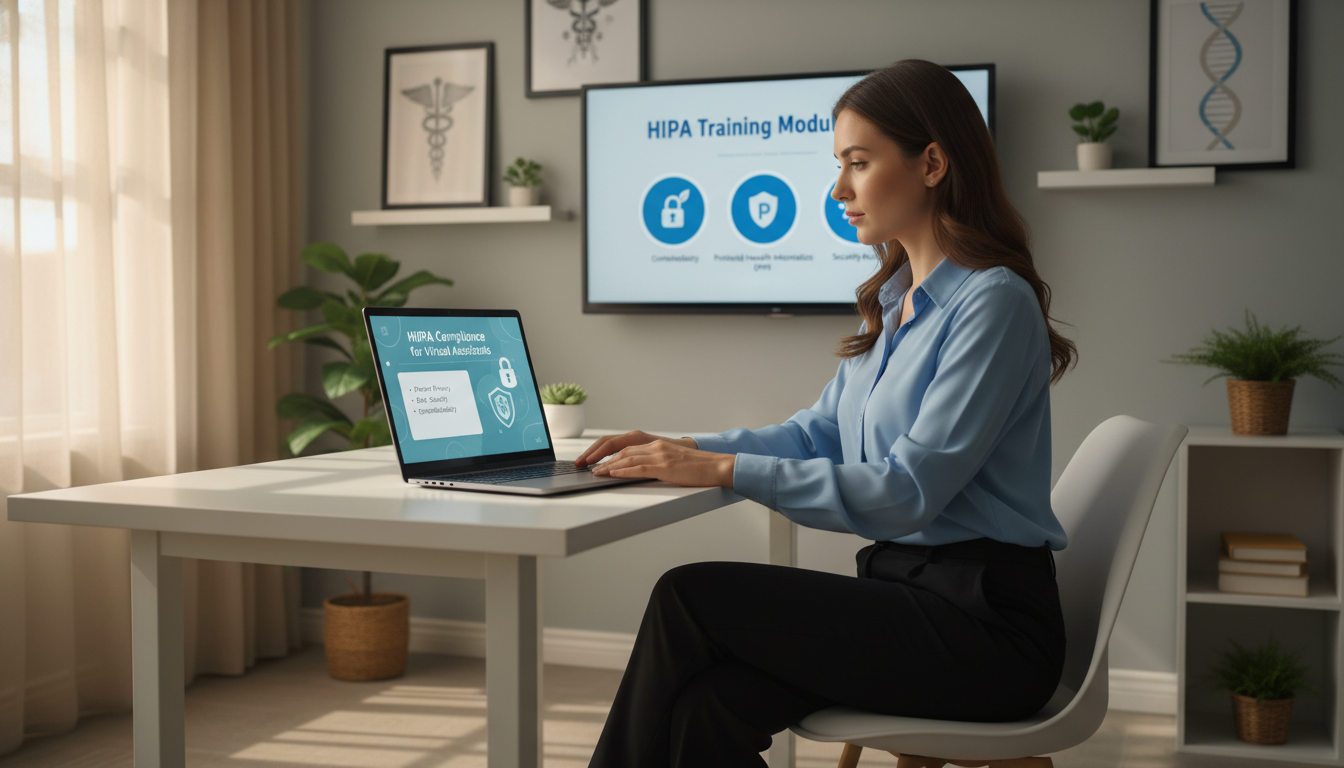
Good HIPAA training programs teach key topics. They help virtual medical assistants deal with real-world challenges. A strong HIPAA training curriculum makes sure your remote staff knows the rules and how to use them every day. Look for courses that cover these four main areas well.
How well your virtual medical assistant learns about privacy and security rules affects your practice’s compliance. They need to know how to apply what they learn right away in their work.
Understanding Protected Health Information Protection
Privacy basics training teaches your virtual medical assistant when and how to use or share protected health information. They learn about the minimum necessary standard. This means they only access the info they need for their job. This helps keep patient data safe.
They study the 18 things that make up PHI. This includes obvious things like names and social security numbers, and less obvious things like medical record numbers and biometric data.
Good training explains how to get authorization. Your virtual staff learns when they need a patient’s written consent to share info. They also learn about exceptions for treatment, payment, and healthcare operations.
Administrative, Physical, and Technical Protections
Security training covers three main areas to protect electronic health info. Administrative safeguards include security management, training, and planning. Your virtual medical assistant learns their part in these policies.
Physical safeguards focus on workstation and device security. Training shows how to keep a home office safe, control access to equipment, and dispose of devices with patient data.
Technical safeguards protect against digital threats. Your assistant learns about access controls, encryption, and audit controls. These track who accesses what information and when.
| Safeguard Type | Key Components | Virtual Assistant Application |
|---|---|---|
| Administrative | Security policies, workforce training, risk analysis | Following protocols, completing annual training, reporting risks |
| Physical | Workstation security, device controls, facility access | Securing home office, locking computers, proper device disposal |
| Technical | Access controls, encryption, audit trails | Using strong passwords, encrypting communications, logging activities |
Identifying and Reporting Security Incidents
Your virtual medical assistant needs to know how to spot breaches. Training tells them what a breach is and what’s not. They learn that breach notification is needed when unauthorized access or use compromises patient info.
They learn how to report incidents fast. They know who to call, what to document, and how quickly. The 60-day notification deadline for affected individuals is a big reason for quick action.
They also learn about keeping records of breaches. They document the breach date, what info was involved, and steps to fix it. This helps protect your practice during investigations.
Empowering Patients Through Knowledge
Patient rights education makes your virtual medical assistant a patient advocate. They learn about the right to access their health records within 30 days. They know how to help patients get their records.
Patients can ask for corrections to their records if they find errors. Your virtual staff learns how to handle these requests and what to do if changes are denied.
They also learn about the right to know when and why their info was shared. Training explains what disclosures need to be documented and how long records must be kept.
They learn about patients’ rights to private communications. Some patients want calls at specific numbers or letters sent to different addresses. Well-trained virtual medical assistants respect these wishes and keep accurate records of requests.
Federal and State Regulations on HIPAA
Before you hire virtual medical assistants, it’s key to know HIPAA rules. These rules have a federal base and state laws on top. Your practice must follow both to keep patient info safe and avoid big fines. Knowing these rules well is vital for making good hiring choices.
Remote medical assistants must follow many health privacy rules. Federal laws set the basic rules everywhere. But, states can add their own rules to protect patients more.
Your virtual assistant must follow the stricter rule, which can be complex. This means you need to pay close attention to hiring and training.
Understanding Federal Protections and Enforcement
The Department of Health and Human Services (HHS) watches over HIPAA rules. Its Office for Civil Rights (OCR) checks if everyone follows the rules. They look into complaints, do reviews, and fine those who don’t follow the rules.
There are four main federal rules for your virtual assistant. The Privacy Rule says how health info can be used and shared. The Security Rule makes sure electronic health info is safe.
The Breach Notification Rule says how to report data breaches. The Enforcement Rule explains how to investigate and punish rule-breakers. These rules are the base of what your virtual assistant must do.

Your practice must make sure your virtual staff knows these rules. Each rule has its own rules that affect how you work every day. Training must cover all four rules well to avoid mistakes.
Navigating Additional State Requirements
Many states have their own privacy laws that are stricter than federal rules. You must follow the stricter rule, which is important if your virtual assistant works in a different state. This is true even if your practice is in a different state.
California’s Confidentiality of Medical Information Act (CMIA) has stricter rules than federal law. Texas has rules about electronic health records and patient consent. Massachusetts requires detailed security plans that go beyond federal rules.
You need to know which state laws apply to your situation. If your practice is in California but your virtual staff is in Texas, you might need to follow both states’ rules. The strictest rule always applies.
Working across state lines needs careful legal checking. You should talk to experts who know both your state and your virtual assistant’s state. This helps avoid missing important rules that could lead to trouble.
Understanding Financial and Criminal Consequences
The government has a system of fines for HIPAA rule-breaking. The fines get higher based on how bad the mistake was. This system encourages everyone to follow the rules closely.
Fines can be from $100 to $50,000 per mistake, depending on how bad it was. The worst mistakes can cost up to $1.5 million. This is a big risk for practices that make many mistakes.
| Violation Category | Penalty Per Violation | Annual Maximum | Knowledge Level |
|---|---|---|---|
| Unknowing | $100 – $50,000 | $25,000 | Individual did not know and could not have known |
| Reasonable Cause | $1,000 – $50,000 | $100,000 | Violation due to reasonable cause, not willful neglect |
| Willful Neglect (Corrected) | $10,000 – $50,000 | $250,000 | Conscious disregard but corrected within 30 days |
| Willful Neglect (Uncorrected) | $50,000 | $1,500,000 | Conscious disregard with no corrective action |
Breaking HIPAA rules can lead to serious penalties. Wrongly sharing health info can cost up to $250,000 and jail for 10 years. These penalties are for those who share info for personal gain or harm.
Your virtual medical assistant can face personal penalties. While your practice is mainly responsible, employees can also be charged. This shows why training them well is so important.
State laws also have their own penalties, which can be added to federal fines. Some states let patients sue for rule-breaking. This means one mistake can lead to fines from different places.
How to Choose the Right HIPAA Training Program
Not all HIPAA training programs are the same. It’s important to know what makes a good program. The quality of your training affects if your virtual medical assistants really get it or just get a certificate.
Choosing the right program helps protect your practice from mistakes. It also makes sure your team knows how to handle sensitive health info.
Investing in good training saves you from risks and makes your staff ready. Look at several things when picking a program. The best ones have lots of content and ways to keep it interesting.
Accreditation and Recognition Standards
Knowing about accreditation helps you find good HIPAA training. The Department of Health and Human Services doesn’t officially accredit programs. But, good providers match their courses with official guidance and best practices.
Look for programs that say they follow current OCR materials. They should also update their content often. This keeps the training up-to-date with new rules.
Choose providers with credentials from groups like the American Health Information Management Association. These show the provider is professional and keeps up with changes. Getting training from known groups adds trust that online courses can’t match.
Certificates are important for more than just showing you finished. They need to have your name, when you did it, what you learned, and who gave it to you. This is important for audits.
Comparing Online and In-Person Training Options
Online training is great for virtual medical assistants. They can do it from home and at their own pace. Online, you can learn anytime, which is good for people with busy schedules.
Online courses are flexible but might not be as interactive. They’re good for basic knowledge but might not answer specific questions. Interactive formats are better for complex topics.
In-person or virtual classes offer live discussions and scenarios. They’re good for asking specific questions and getting answers right away. But, they can be expensive and hard to schedule.
Hybrid programs mix online learning with live sessions. They’re cost-effective and interactive. This way, you get the best of both worlds.
Evaluating Program Duration and Investment Costs
Training programs can last from two to eight hours. Shorter ones cover basics, while longer ones include more details. The time needed depends on the job your virtual medical assistant will do.
Prices vary based on the provider, what’s covered, and how it’s delivered. You might spend $30 to $300 per person for good training. Cheaper options might not cover as much, while more expensive ones might include extra support.
Remember, you’ll need to keep your team updated with refresher courses. These cost less than the first training and usually take one to two hours. Regular updates keep your team up-to-date and focused on compliance.
Think about the value of the training, not just the cost. Good training reduces the risk of big fines. It also saves money by avoiding the need for more training or staff changes.
| Training Feature | Online Self-Paced | Instructor-Led Virtual | Hybrid Model |
|---|---|---|---|
| Initial Training Duration | 2-6 hours over multiple sessions | 4-8 hours in scheduled blocks | 3-6 hours combined formats |
| Cost Range Per Person | $30-$150 | $150-$300 | $100-$250 |
| Flexibility Level | Complete schedule control | Fixed session times required | Moderate with some flexibility |
| Interaction Opportunities | Limited to pre-recorded content | Real-time questions and discussions | Combination of both approaches |
| Best Suited For | Geographically dispersed teams | Practices needing customized scenarios | Balanced cost and engagement needs |
Choose a program that fits your practice’s needs and budget. Look at sample content, check certificates, and ask for references. The right program will give your team the knowledge they need and keep your practice compliant.
Content Delivery Methods for HIPAA Training
There are many ways to deliver HIPAA training. This lets you pick what works best for your team’s schedule and learning style. The method you choose affects how well your team learns and uses this knowledge every day.
Choosing the right training method is key. Remote healthcare workers need training that fits their work style. The right method makes learning fun and engaging.
Self-Paced Digital Learning Systems
E-learning platforms are a top choice for HIPAA training. They offer courses that your team can do at their own pace. Systems like Relias, HealthStream, and HIPAA Exams have videos, infographics, and quizzes to help understand complex rules.
These platforms are great because they let your team learn anywhere, anytime. This is super helpful for teams in different time zones. They can spend more time on hard topics without rushing.
These platforms also let you see how your team is doing. You can see who needs help and track who has finished training. They even remind you when certifications need to be renewed.
Scenario-based learning helps your team practice real-life situations. This way, they learn to apply HIPAA rules in real situations. It helps them make good privacy decisions.
Facilitated Group Learning Experiences
Interactive workshops let your team learn with trainers and others. You can use Zoom or Microsoft Teams for this. It’s a chance to ask questions and solve problems together.
These workshops include role-playing. It’s a safe way to practice handling privacy issues. This hands-on learning builds confidence in dealing with sensitive topics.
Learning together makes your team more accountable and connected. Sharing challenges helps everyone find better solutions. This teamwork strengthens your compliance culture and helps remote workers feel part of a team.
Scheduled Expert-Led Training
Webinars and live sessions offer learning with experts. They cover current trends and updates in HIPAA. These sessions are usually 60-90 minutes long and focus on specific topics.
Live sessions let your team ask questions right away. Experts share real examples to make learning more memorable. This helps your team see why following rules is important.
Many use a mix of training methods for the best results. For example, start with e-learning, then have live sessions for more discussion. This way, you get the best of both worlds.
The best training programs mix different methods. This helps everyone learn in their own way and reinforces important ideas.
Recording live sessions makes them available anytime. This is great for new hires and for reviewing complex topics. It’s a big help for your compliance program.
Assessing Your Virtual Medical Assistant’s HIPAA Knowledge
Testing your virtual medical assistant’s HIPAA knowledge shows if they really understand the training. You need good ways to check if they can use privacy and security rules every day. This keeps your practice safe and builds trust with patients.
Don’t just check off HIPAA knowledge once and forget. How you test their knowledge affects how well they protect health info. The methods you use today help your practice stay ready for tomorrow.
Comprehensive Testing Approaches and Certification Standards
Start with a pre-test to see what your virtual medical assistant knows before training. This helps you find gaps and make training better. Most good programs want scores of 80% or higher after training.
Don’t just use simple questions for your post-training test. Use real-life scenarios to test their understanding. Ask them to decide if they can share patient info with a family member or handle unauthorized access.
- Training dates and details
- Pre-test and post-test scores
- Certificate copies
- Forms signed by your virtual assistant
- Records of any extra training
These records show you’ve made sure your virtual medical assistant knows their duties. Keep them for at least six years, as laws might ask for them during investigations.
Building a Schedule for Ongoing Knowledge Assessment
HIPAA knowledge isn’t something you check once and forget. Rules change, new tech comes out, and knowledge fades. Make sure to do annual refresher training to keep up.
Many experts say to check in more often. Try quarterly mini-tests that take 10-15 minutes. These quick checks keep important ideas fresh without overwhelming your team.
Think about sending monthly tips on compliance. Short reminders about common issues keep security top of mind. This is better than one big training session that everyone forgets.
Regular tests also help spot when someone needs extra help. If your virtual medical assistant always struggles with certain topics, give them targeted training. This helps your practice and patients stay safe.
Testing Through Real-World Situations and Case Analysis
Use real-life scenarios to test your virtual medical assistant. This shows how they’ll do in real work situations. It finds weaknesses that simple questions might miss.
Your case studies should cover things your virtual staff does every day:
- Phone inquiry scenarios: Someone calls claiming to be a patient’s spouse and wants test results
- Email security situations: Getting a suspicious message that seems to be from a patient but asks for weird things
- Workstation security challenges: Figuring out the right steps when working from a shared space
- System transition protocols: Handling patient info when switching between different systems
- Breach response situations: Spotting security issues and knowing how to report them
Write out these scenarios and ask your virtual medical assistant to explain their steps. Their answers show if they’d make the right choice and why.
Use role-playing in live training to test their skills in real time. This shows how they handle pressure, which is more like real work than written tests. You’ll see where they might hesitate or get confused, which could lead to mistakes.
Start with simple scenarios and get harder as your virtual medical assistant gets better. This way, they learn step by step and are ready for anything in healthcare.
The Role of Virtual Medical Assistants in HIPAA Compliance
Virtual medical assistants protect patient privacy. They handle sensitive information daily. Their role is key to your practice’s success.
They must follow strict rules to keep data safe. This includes daily actions and reporting protocols. It’s important to keep your practice safe from breaches.
Setting clear expectations for your virtual medical assistant is important. It ensures they follow rules and protect patient information. Their actions affect your practice’s reputation.
Daily Responsibilities and Obligations
Your virtual medical assistant has specific VMA compliance duties. They must verify patient identity before discussing health information. They use secure channels to send PHI.
They follow the minimum necessary standard. This means they only access information needed for their tasks. They also keep workspaces secure, even when working from home.
| Compliance Responsibility | Required Action | Frequency | Verification Method |
|---|---|---|---|
| Patient Identity Verification | Confirm identity using two data points before discussing PHI | Every patient interaction | Documentation in communication logs |
| Secure System Access | Log out completely when stepping away from workstation | Every break or interruption | Automatic timeout settings and audit logs |
| Minimum Necessary Access | Open only records directly related to assigned tasks | Every record access | System access reports reviewed monthly |
| Workspace Security | Position screens away from windows and ensure privacy during calls | Continuous during work hours | Workspace audits and self-assessments |
| Device Security Updates | Install security patches and software updates immediately | As released by vendors | IT department monitoring and compliance checks |
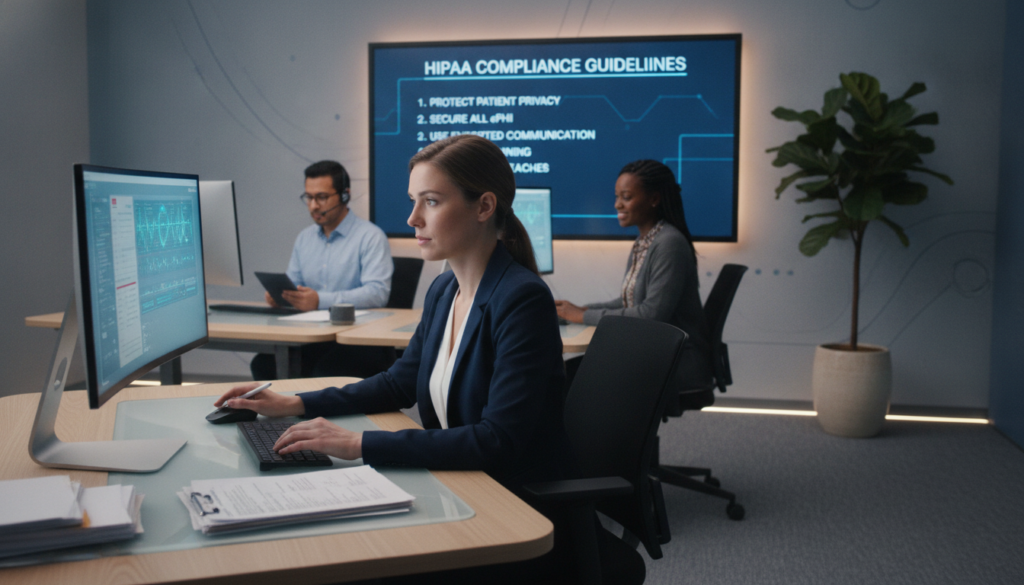
System security is important. Your virtual assistant must use approved devices with updated security. They should never use public Wi-Fi to access patient information.
Reporting Procedures for Security Incidents
Your virtual medical assistant must report any security incidents right away. This includes lost devices, unauthorized access, and phishing attempts. They should report any breach of patient information.
Clear reporting channels are key. Your practice should have multiple ways to report incidents. This encourages quick reporting and helps minimize breach impact.
Reporting incidents is safe. Your practice should encourage transparency. Document every report, even false alarms, to show your commitment to compliance.
Handling Patient Information Safely
Secure information handling is a must. Your virtual medical assistant should use strong passwords and two-factor authentication. This makes unauthorized access hard.
Email encryption is required for PHI. Your assistant must ensure encryption is active before sending emails. They should use secure file transfer protocols for documents.
Electronic file storage is also important. Your assistant should store files on encrypted devices or approved cloud services. They should never discuss patient information in public spaces.
Common HIPAA Violations to Avoid
Keeping HIPAA violations at bay is a big job. Even small mistakes can lead to big problems. Your virtual medical assistant team faces many situations where one wrong move can cause trouble. Knowing the most common violations helps you set up defenses early.
The Office for Civil Rights checks thousands of complaints yearly. Many of these are because of easy-to-avoid errors. By knowing these common mistakes, you can teach your HIPAA compliant VMA team to steer clear of them.
Unauthorized Access to Patient Records
One big HIPAA violation is when virtual assistants look at patient records without permission. It’s surprising how often this happens.
Team members might want to see records of famous people, neighbors, family, or friends. Even if they don’t mean to, this is a big no-no. Access to patient info is only for doing their job.
Keeping detailed logs of who looks at what records is key. These logs should show who accessed what, when, and why. Regular checks on who’s accessing what can catch odd behavior early.
Your training should make it clear that looking at records without permission is serious. Tell your team that every login is watched and checked. Let them know that looking out of curiosity can lead to losing their job, facing criminal charges, and big fines.
Inadequate Training and Awareness
Not enough or outdated training can lead to big problems. Virtual assistants who don’t know what’s protected health info are a risk.
They might not spot phishing, don’t know how to share info right, or miss when something needs to be reported. Without the latest training, they can’t keep patient info safe.
The Office for Civil Rights sees not training enough as a serious mistake. This can lead to much higher fines than if it was an accident. Your training program must keep up with new threats and rules.
Training should be ongoing, not just a one-time thing. Your HIPAA compliant VMA team needs regular updates on new threats and rules. Plan to train them every few months to keep them sharp.
Here are key things your virtual assistants need to know:
- What protected health information and identifiers are
- How to spot social engineering and phishing
- How to check patient identity before sharing info
- How to report suspicious activity right away
- The serious consequences of HIPAA violations for everyone involved
Mishandling of Electronic Communications
Errors with electronic messages are a big problem for virtual medical assistants. Digital chats can easily lead to breaches if not done right.
One common mistake is sending emails with patient info without encryption. Your team might think they’re saving time, but it’s a big no-no.
Other mistakes include:
- Talking about patient cases on unsecured apps or social media
- Using personal email for work with patient info
- Showing patient info on screens during calls
- Not securing mobile devices with passwords and encryption
- Taking screenshots of patient data and storing them on personal devices
Having clear rules on how to communicate helps avoid confusion. Your team needs to know which ways are okay for sharing patient info.
Give your virtual assistants secure ways to communicate. If they need to send data, use encrypted emails. For team chats, make sure they use systems that follow HIPAA rules.
Reminding them about safe communication often helps. Create quick guides for them to check when they’re unsure. Make it easy for them to report any compliance mistakes without fear of getting in trouble.
Your checklist for secure communication should include:
- Checking that all devices have the latest security software
- Confirming that virtual assistants use VPNs when working from home
- Changing passwords on all systems with patient data regularly
Best Practices for Maintaining HIPAA Compliance
Starting strong with your virtual medical assistant team is key. HIPAA compliance is not just for the beginning. It’s an ongoing process that keeps up with new rules and threats.
Your practice needs systems for ongoing compliance. These systems protect patient info and show you care about privacy. Here are some ways to keep up with compliance.
Keeping Knowledge Current Through Consistent Education
Your virtual medical assistants need annual refresher training at minimum to stay up-to-date on HIPAA. New rules come out often, and old knowledge can lead to big problems. Make sure to schedule these training sessions every year.
More training is needed for new situations. This includes when you start new tech, face security issues, or when rules change. Focus on real-world examples, not just theory.
Monthly newsletters can help keep HIPAA topics fresh. These short updates keep privacy and security in mind. They also share lessons from others’ mistakes.
Have quarterly meetings for compliance talks. These sessions help your team:
- Review recent data breaches in healthcare
- Talk about new security threats and how to prevent them
- Share questions and concerns safely
- Work on compliance challenges in your workflow
- Celebrate your compliance wins
Documentation proves your compliance efforts during audits. Keep detailed records of every training session. Include dates, topics, attendees, and results. This shows your practice’s dedication to compliance and protects you from audits.
Protecting Information Through Technology Standards
Secure healthcare practices need the right tools for every task. Your virtual medical assistants should never send patient info through regular email or unsecured messaging apps. These platforms lack the security HIPAA requires.
Use encrypted email services for patient info messages. Paubox is a good option that encrypts messages automatically. This keeps info safe without extra steps for recipients.
Use secure patient portals for communication with patients. These platforms are safe for patients to access their info. They also keep records of who accessed what and when.
For telehealth, use HIPAA-compliant video platforms. Zoom for Healthcare is a good choice with features like waiting rooms and encryption. Make sure your Zoom account is the healthcare version.
Your tech needs should include:
- VPN connections for remote access
- Two-factor authentication for logins
- Automatic logout after inactivity
- Approved secure messaging apps for healthcare
- Microsoft Teams set up for internal use
Make a list of approved tools and banned platforms. This clears up any confusion. Update this list when you try new tech or stop using old services.
Managing Records According to Legal Requirements
HIPAA says you must keep training records for at least six years from when they were made or last updated. This rule applies to all compliance records, not just medical files. Your virtual medical assistants need to know and follow this rule.
Each type of document has its own retention time. Medical records need longer than training records or letters. Make a clear plan for how long to keep each type of document:
| Document Type | Minimum Retention Period | Disposal Method |
|---|---|---|
| Training Records | 6 years from completion | Secure electronic deletion |
| Medical Records | 6-10 years (state-dependent) | Certified shredding or secure wiping |
| Billing Documentation | 7 years from service date | Certified shredding or secure wiping |
| Patient Correspondence | 6 years from last contact | Secure electronic deletion |
How you dispose of documents is as important as how long you keep them. Physical documents need certified shredding. This proves you disposed of sensitive info correctly and protects you from legal trouble.
Electronic files should be securely wiped, not just deleted. Regular delete doesn’t erase data from storage devices. Use special software to overwrite data, making it unrecoverable. Keep records of each disposal action.
Have your virtual medical assistants check for records nearing their retention deadline every quarter. This prevents early disposal and ensures info is destroyed on time. Regular checks also help find storage problems early.
Do annual audits of your document retention practices. These audits find any issues and show you’re serious about following HIPAA rules. They help keep your practice in line with VA compliance standards.
Implementing a Culture of Compliance
Creating a workplace where HIPAA compliance is key needs leadership, open talks, and learning. A strong compliance culture makes your team see patient privacy as a core value. This changes how they handle sensitive info every day.
Your compliance culture is the base for all security and training. Without it, even the best policies fail because team members see them as just rules. When compliance is part of your practice’s core, your virtual medical assistants make privacy choices naturally.
Setting the Tone from the Top
Your leadership role shapes your team’s compliance culture. Showing you care about patient privacy through actions shows your virtual medical assistants that it matters. This means talking about privacy in team meetings, using security tools, and holding everyone to the same standards.
Consider having a compliance officer or privacy officer. They can answer HIPAA questions and keep training up to date. Even small practices need someone to watch over healthcare team accountability.
Leadership behaviors that strengthen compliance include:
- Locking computer screens when stepping away from workstations
- Never discussing patient cases in public areas or unsecured locations
- Immediately reporting security incidents without delay
- Participating in training sessions alongside team members
- Recognizing and rewarding compliance-conscious behavior
When your virtual medical assistants see you following these rules, they know patient privacy is non-negotiable. Your actions show them that privacy is more important than any policy or training.
Creating Safe Channels for Discussion
Your virtual medical assistants should feel safe asking questions and reporting concerns. Many breaches are found late because of fear of punishment. Practices with open communication catch and fix problems early.
Healthcare team accountability grows when your team feels safe speaking up. Use anonymous reporting for those who are scared to talk directly. Have regular compliance check-ins for team members to discuss data handling challenges.
Answer questions and concerns in a helpful way, not as punishment. Treat HIPAA questions as chances to learn for everyone. A compliance culture values openness over blame, encouraging problem-solving.
The goal is creating an environment where asking “Is this HIPAA-compliant?” becomes routine. Your virtual medical assistants should feel empowered to check procedures before rushing.
Evolving Your Training Approach
Good compliance programs regularly check if training works and change it if needed. Your compliance culture grows when you use feedback to improve training. This ensures your virtual medical assistants get relevant, engaging training.
Do compliance risk assessments to find weak spots. Use these to focus training and resources. Turn near-misses into lessons to help your team learn without actual breaches.
Methods for continuous improvement include:
- Quarterly feedback surveys asking for training clarity
- Annual reviews of incident reports to find training gaps
- Monthly updates on new HIPAA rules
- Peer learning sessions for sharing best practices
- Real-world scenarios in training modules
Keep up with new rules and best practices through professional groups and newsletters. Update training quickly when new guidance comes out. This shows your team that accountability includes staying informed.
Investing in ongoing training reduces risk, boosts team confidence, and builds patient trust. Virtual medical assistants who get regular, relevant training stay vigilant about patient info.
Conclusion: Investing in HIPAA Training
Choosing a virtual medical assistant needs careful thought about HIPAA training. This step keeps your practice safe from legal risks. It also makes sure patient data stays private.
The right training turns weak points into strong ones for your healthcare team.
The Critical Role of HIPAA Training
HIPAA training makes your virtual medical assistant a trusted team member. They learn about keeping patient info private and secure. This training makes them just as reliable as your in-office staff.
They handle electronic health records with great care.
Long-term Benefits for Your Practice
Good training brings big benefits to your practice. It lowers the chance of data breaches and fines. Patients trust you more when they see you care about their privacy.
Your team works better and makes fewer mistakes. This is like how healthcare BPO services keep everything in line. The cost of training is worth it for the safety and trust it brings.
Final Considerations Before Hiring
Make sure you check if they have current HIPAA certification. Ask them questions to see if they really get it. Make sure they know they have to follow rules.
Plan to keep training them so they stay up to date. Hiring without the right training is risky. But, the right training makes your team strong and safe.