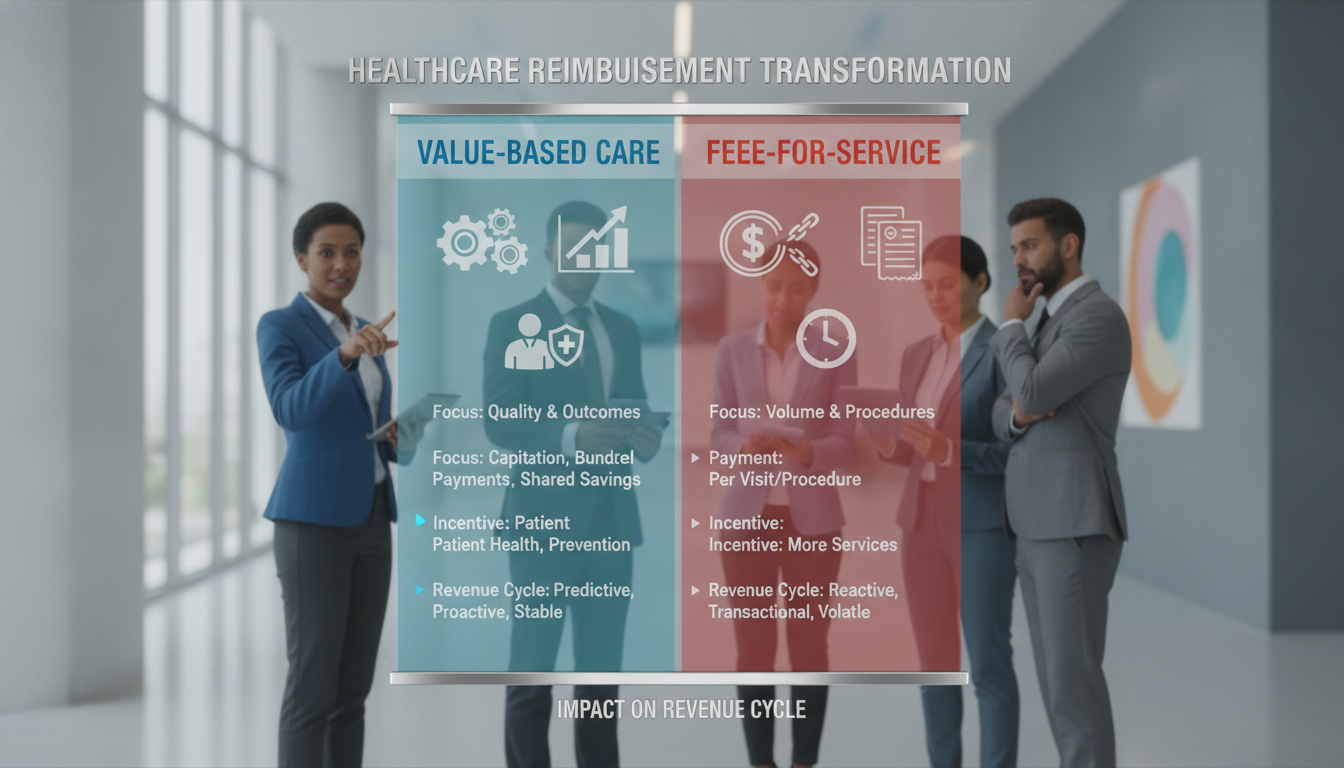
By 2027, nearly 60% of all healthcare payments will be made through new models, not the old fee-for-service way. This big change will deeply affect how your group makes money.
The way you used to get paid is going away fast. Now, you’re judged on how well patients do and how good your care is. This big change touches every part of your money work.
Knowing the difference between these models is key. Your group’s money health depends on changing how you bill, who you hire, and what tech you use.
The new value-based care way needs different plans than the old ones. Every step, from starting care to getting paid, needs new steps and skills. Your money flow, how you use resources, and planning for the future must all change.
Key Takeaways
- Payment models are shifting dramatically, with alternative structures projected to dominate by 2027
- Traditional billing approaches no longer align with current reimbursement requirements
- Financial sustainability now depends on understanding outcome-based payment frameworks
- Every stage of your billing process requires adaptation to new quality-focused metrics
- Cash flow management strategies must account for different payment timelines and structures
- Technology investments and staff training need realignment with evolving reimbursement models
Understanding Value-Based Care and Fee-for-Service Models
Your revenue cycle strategy depends on knowing the different payment ways. These ways shape your work, from how you document to what tech you use. The move from old payment ways to new ones is big in healthcare finance.
Most providers now use a mix of healthcare payment models. You might get paid by service for some patients and by value for others. This mix makes your work more complex and needs different ways to handle each payer.
Knowing the basics of each model helps you make smart choices. This includes how to talk to payers, what tech to buy, and how to care for patients. The differences are not just in how you get paid but also in risk, quality, and how you engage with patients.
How Value-Based Care Works
Value-based care pays you based on patient health and quality, not just services. Payers reward you for keeping patients healthy and preventing hospital stays. Your pay depends on how well you improve patient health and happiness.
This model focuses on preventive care and managing chronic diseases. You get bonuses for meeting health goals like controlling blood pressure. But, you might lose money if patients get sicker or are not happy with care.
Value-based plans often share savings, use bundled payments, or capitation. These plans make you share some financial risk with payers. You win when you save money and deliver quality care. But, you lose when things don’t go as planned.
How Fee-for-Service Functions
Fee-for-service is the old way of paying for care. You get paid for each service, test, or visit. This method has been around for a long time and is common today.
With fee-for-service, your money comes from how many patients you see. Each service has a set price, so more patients mean more money. This makes your income predictable based on how busy you are.
Fee-for-service doesn’t risk your money much because you get paid no matter what. But, it might encourage too many tests and procedures. You focus on seeing more patients and doing more services. For good revenue cycle management and denial prevention, you need to document and code well.
Contrasting Payment Approaches
The main difference between fee-for-service vs value-based models is how they see success and risk. These models change how you work with payers and manage your finances. Knowing these differences helps you adjust your work to meet payer needs.
Another big difference is when you get paid. Fee-for-service gives you money right away, but value-based care might wait. This wait can make managing money harder and needs careful planning.
| Payment Dimension | Fee-for-Service Model | Value-Based Care Model | Impact on Revenue Cycle |
|---|---|---|---|
| Payment Trigger | Each service, procedure, or visit provided | Achievement of quality metrics and health outcomes | FFS provides immediate billing opportunities; VBC requires performance tracking before payment |
| Financial Risk | Minimal provider risk; payer absorbs most costs | Shared risk between provider and payer | VBC demands reserves for possible penalties and outcome-based adjustments |
| Revenue Predictability | Highly predictable based on volume | Variable based on performance benchmarks | FFS enables accurate forecasting; VBC creates revenue uncertainty |
| Documentation Focus | Service justification and medical necessity | Outcomes tracking, quality measures, patient engagement | VBC requires expanded data collection beyond traditional clinical documentation |
| Care Coordination | Optional; not financially incentivized | Essential; directly impacts reimbursement | VBC demands investment in care management infrastructure and staff |
These big differences mean you need different ways to work, document, and track performance. Your billing team must know which model to use for each patient. It gets even harder when patients have different payers for different services.
The Impact of Value-Based Care on Your Revenue Cycle
When you switch to value-based care, your revenue cycle changes a lot. This change affects how money comes into your organization and when. You’ll need to adjust to new ways of handling money.
Value-based care makes your financial processes more complex. It’s not just about billing anymore. You’ll deal with performance metrics, quality checks, and risk-sharing agreements. These changes mean you need new strategies for managing money.
Knowing about these changes helps you get ready for success. You’ll face challenges like cash flow timing and payment structure changes. But with the right planning and systems, you can handle these changes well.
Cash Flow Considerations
Value-based care changes how you handle cash flow. You won’t get paid right away after services. Payments come in bundled payments, bonuses, and reconciliations that take months.
This change makes managing cash harder. You need enough money to cover expenses while waiting for payments. Many practices keep three to six months of expenses in reserve during the transition.
Payment structures also hold back money. Payers might keep 10% to 20% of payments in risk pools or for quality withholdings. These funds are released only after you meet certain targets, making cash flow harder to predict.
To manage these challenges, you should:
- Make detailed cash flow forecasts for delayed payments
- Get lines of credit to cover gaps during transition
- Watch accounts receivable aging reports closely, focusing on value-based contracts
- Use separate systems to track fee-for-service and value-based payments
- Save money for value-based care changes
Payment Timing and Structure
Payment changes are not just about delays. Value-based contracts have multi-layered payment structures that come at different times. You might get base payments monthly, bonuses quarterly, and savings distributions annually.
Your finance team needs to understand these complex payment schedules. A typical value-based contract has several payment parts that arrive at different times. Base payments might come monthly, but bonuses often come quarterly or semi-annually.
Retrospective reconciliations add more complexity. Payers review your performance and adjust payments months later. You might get extra payments for good performance or face demands for money back if costs are too high.
| Payment Component | Typical Timing | Calculation Basis | Revenue Impact |
|---|---|---|---|
| Base Capitation | Monthly | Per-member per-month rates | Predictable steady income |
| Quality Bonuses | Quarterly or Semi-Annual | Performance metrics achievement | Variable, performance-dependent |
| Shared Savings | Annual | Total cost of care vs. benchmark | Largest but most delayed payment |
| Risk Pool Distributions | Annual | Withheld amounts minus losses | Uncertain until year-end settlement |
These changes need advanced financial tracking. You need systems to predict when and how much you’ll get paid. Your budgeting must account for this variability to avoid overestimating revenue.
Managing Financial Risks
Value-based care brings financial vulnerabilities you didn’t have before. You take on responsibility for outcomes and costs. This means your income depends on things outside your control.
Not meeting quality benchmarks is a big risk. If you don’t meet targets, you lose bonuses and might face penalties. These benchmarks often require very high achievement rates, leaving little room for error.
Going over budget is another big risk. If you spend more than planned, you lose money. Unexpected costs, like hospital stays or expensive treatments, can hurt your profits.
The type of patients you have also affects your money. If your patients are sicker than expected, your costs go up while your payments stay the same. This risk requires careful attention to how you manage patient health.
To protect against these risks, you should:
- Risk stratification systems to find high-risk patients early
- Stop-loss insurance to protect against very high costs
- Financial reserves for 15-20% of at-risk revenue for unexpected costs
- Regular variance analysis to compare costs and budgets monthly
- Contract review processes to ensure you’re protected
Your financial risk management strategy should balance being part of value-based care with protecting against too much risk. Start with contracts that limit your downside risk before moving to full-risk models. This gradual approach helps you build skills while managing financial changes well.
Key Components of a Value-Based Care Revenue Cycle
The shift to RCM value-based care needs a detailed framework. It must have parts that work together to improve your money performance. Unlike old billing systems, your new system focuses on quality and patient outcomes.
You need three main parts to do well in this new payment system. Each part is important for keeping and growing your money. Together, they make a system that links good care with stable finances.
Active Participation and Patient Satisfaction
Your money from value-based contracts depends on how involved your patients are in their care. When patients help plan their care and talk with their doctors, your results get better. Better results mean more money from payers.
Patient happiness scores now affect your money. Payers look at these scores when figuring out how much to pay you. If patients aren’t happy, you might get 10% to 15% less money.

You need good ways to talk to patients to get them involved. This means explaining treatments clearly and making it easy for patients to ask questions. Health literacy programs help patients understand their health and why following their care plans is important.
Here are some ways to get patients more involved:
- Send reminders for appointments by text, email, and phone
- Use patient portals for easy access to health info
- Make educational materials easy to read and in different languages
- Call patients after visits to make sure they understand their care
- Ask patients how they feel to find ways to get better
These steps help keep patients involved in their health. This can bring in three to five dollars for every dollar you spend.
Analytics Capabilities and Performance Tracking
Your success in value-based payments needs strong data tools to watch quality. Without good data systems, you can’t find problems, track costs, or show value to payers. This is the tech base of your money system.
Real-time dashboards let you see important numbers right away. You can see who’s doing well, who needs help, and where costs are too high. This lets you fix problems fast to keep your money safe.
Predictive tools spot patients at risk early. They look at past data and current health to find patients likely to get sick or need emergency care. Helping these patients early saves money and improves health, which means more money for you.
Your reporting systems need to track many things:
- Quality measures for your contracts
- Costs for different patient groups
- How happy patients are
- Where care is missing and how to fix it
- How providers compare
Many groups spend $500,000 to $2 million on data tools for value-based care. This money helps you do better in contracts and get more money. Your data skills are key to success in new payment models.
Integrated Care Coordination and Management
Your money under value-based deals depends on smooth care across all settings. When patients move between doctors or places, bad communication can cause problems. These problems hurt your scores and cost you money.
Good care coordination needs staff who watch patients all the way. Care managers make sure patients get follow-up care, go to appointments, and see specialists. This stops problems that cost you money.
Systems for sending patients to specialists make care better. When doctors talk well, patients get better care. This means fewer trips to the emergency room and hospital, which saves you money.
Checking in with patients after they leave the hospital is key. Patients who get follow-up care soon have fewer hospital visits again. This is important because many deals penalize you for hospital visits.
Your care plan should include:
- Plans for when patients leave the hospital
- Checking medications to avoid mistakes
- Team talks about hard cases
- Systems for doctors to talk to each other
- Checking for things outside of health that affect care
Groups with strong care plans see 20% to 30% fewer hospital visits. This means more money for you. Your investment in care coordination pays off through better health and more money.
The Role of Technology in Value-Based Care
The shift to value-based care needs strong technology. It must go beyond old billing systems. Your organization needs a digital base for quality, care coordination, and finance.
Without the right tech, showing value and tracking performance is hard. You’ll miss out on the revenue from new contracts.
Technology links clinical excellence with financial success. The systems you choose today will help you succeed in value-based contracts. Knowing which tools are key helps you make smart choices and avoid mistakes.
Your EHR System as a Quality Engine
Your electronic health record must grow from a simple tool to a full platform. It should track quality and manage health populations. Modern value-based care IT needs EHRs that spot care gaps and track clinical measures.
The right EHR flags patients for preventive care. It tracks diabetes, cancer screenings, and medication adherence. This proactive approach helps meet quality benchmarks for bonus payments.
Your EHR should also offer real-time clinical support. It guides providers to best practices during patient visits. This improves outcomes and meets payer quality needs.
Consider these key EHR features for value-based success:
- Automated quality measure tracking and reporting dashboards
- Care gap identification with patient outreach tools
- Risk stratification to prioritize high-need patients
- Clinical decision support integrated into provider workflows
- Team communication features for coordinated care delivery
Advanced Revenue Cycle Management Platforms
Old revenue cycle software can’t handle value-based contracts. You need platforms for managing bundled payments and shared savings. The right tech gives you insight into contract performance before it ends.
Modern RCM systems model contracts and predict revenue. They show how quality scores or utilization patterns affect your finances. This helps you make strategic decisions.
Your RCM platform should handle multiple payment streams. It reconciles fee-for-service, quality bonuses, and shared savings. Without this, you might miss out on money.
Look for RCM software with these value-based features:
- Contract modeling and performance projection tools
- Multi-payer quality metric dashboards
- Bundled payment episode tracking and reconciliation
- Shared savings calculation and distribution management
- Automated variance detection for contract compliance
Virtual Care Technologies for Population Management
Telehealth and remote patient monitoring are key for managing patients. They help you deliver care beyond office visits. This approach improves quality and prevents costly complications.
Remote monitoring tracks vital signs and symptoms. It lets you intervene early, preventing emergencies. This is key for value-based contracts.
Telehealth improves access for patients. It leads to better medication adherence and follow-up. It also opens new revenue streams.
The virtual care IT you build should work with your EHR and patient platforms. This ensures virtual care boosts both clinical and financial outcomes. It’s a key part of your value-based performance.
Virtual care technologies prepare you for new payment models. Early investment in these technologies gives you a competitive edge. You’ll be ready to capture new revenue streams while delivering accessible, coordinated care.
Challenges of Transitioning to Value-Based Care
Switching to value-based care is tough. It tests your ability to adapt and your resources. The fee-for-service vs value-based transition is a big change. Knowing these challenges helps you plan and use your resources wisely.
You’ll face many barriers, from team resistance to big financial needs. Each challenge needs careful planning and commitment from everyone.
Resistance to Change
Your doctors and staff will find it hard to change from fee-for-service. They’re used to working in a certain way. Now, they need to focus on quality over quantity.
They might worry that spending more time on preventive care lowers their productivity. They might think the new model won’t help them financially. This can lead to resistance or even opposition.
Your admin team also faces challenges. They’re used to simple billing but now need to learn complex systems. The new rules can be frustrating, making them feel overwhelmed.
“The biggest barrier to change isn’t the new systems—it’s people’s resistance to change.”
To overcome this, you need to manage change well. Educate your team on how value-based care benefits everyone. Showing early successes can win over skeptics.
It’s also key that your leaders are on board. If they’re not united, mixed messages can confuse your team.
Financial Investment and Resources
Starting value-based care requires a lot of money upfront. You’ll need to spend on new technology before seeing benefits. This can be hard for many organizations.
Technology costs can be very high, up to seven figures. You’ll need new systems for tracking quality. These systems are key to your new payment model.
You’ll also need to hire more staff. People like care coordinators and data analysts are essential. These roles add to your costs, which can be tough during the transition.
Some providers look at outsourcing to manage costs. Outsourcing can help during this time.
It can take 18 to 36 months to see a return on your investment. You’ll be running two systems at once. This can be hard on your finances and staff.
| Investment Category | Typical Cost Range | Timeline to ROI |
|---|---|---|
| Technology Infrastructure | $250,000 – $2,000,000 | 24-36 months |
| Additional Personnel | $150,000 – $500,000 annually | 18-24 months |
| Training and Education | $50,000 – $200,000 | 12-18 months |
| Process Redesign | $75,000 – $300,000 | 18-30 months |
Phasing your investments can help with cash flow. Start small, with pilot programs, before going big. This reduces risk and shows the value of the investment.
Measurement and Outcomes Evaluation
Tracking quality metrics for value-based care is complex. You need to manage data well. This includes data governance and analytics.
Attribution issues can cause confusion. It’s hard to know who’s responsible for outcomes. This can affect your scores unfairly.
Risk adjustment adds more complexity. Your patient’s health status affects outcomes. If the formulas don’t account for this, you’ll be unfairly judged.
Data quality is a big problem. Errors in coding and system failures can mess up your metrics. This can make it seem like you’re not doing well, even if you are.
Benchmarking is also a challenge. The standards might not fit your situation. Providers in different settings face different challenges, but are judged the same way.
You need strong data validation to ensure accuracy. Regular audits help catch and fix data issues. Having skilled data analysts is key to overcoming these challenges.
Strategies for Implementing Value-Based Care
Starting RCM value-based care needs a plan. This plan should get your team ready, improve payer relationships, and set clear goals. Success comes from working together on people, operations, and measuring things. These steps help build a strong base for value-based care.
Adopting value-based care is more than just changing policies. It’s about changing how everyone works. Everyone needs to focus on quality and patient results. Here are ways to make this change smoothly and quickly.
Building a Knowledge-Ready Workforce
Your team is key to success in value-based care. They need to learn a lot about quality, care coordination, and how to document things. Every team member must understand their specific role in achieving value-based objectives.
Start with training for each role. Clinical staff need to know about documenting for quality. Billing staff need to learn new coding and claim rules for value-based contracts.
- Performance monitoring and dashboard interpretation
- Patient engagement techniques that improve satisfaction scores
- Care coordination workflows that reduce readmissions
- Financial modeling for value-based revenue projections
- Risk stratification and population health management
Creating a learning culture means making education continuous. Offer regular refresher sessions and online learning. Have experienced staff guide others. This keeps your team up-to-date with value-based changes.
Organizations that invest in staff training adapt to value-based care 40% faster. They also see big improvements in quality.
Strengthening Partnerships with Insurance Organizations
Building strong payer relationships is key. These partnerships help clarify contracts, solve payment issues, and find ways to make more money. Transparency and regular talks are the base of good payer work.
Have regular meetings with payers to talk about performance, payments, and challenges. This helps solve problems before they hurt your money. You also learn what payers expect and show you’re committed to success.
Your work with payers should include:
- Having a person just for payer work
- Using shared data for tracking
- Working together on quality projects
- Having clear ways to solve disputes
- Going to payer training and councils
Working together on payment issues helps more than fighting. Payers like providers who solve problems with data. This teamwork often leads to better contracts and faster fixes that help your money.
Establishing Clear Accountability Systems
Setting up performance goals is key. You need to track and report on these goals clearly. Performance-based tactics need exact tracking and clear reports.
First, pick the key goals for value-based care. These are quality, patient happiness, readmissions, and care coordination. Then, set targets for each department that add up to your big goals.
| Metric Category | Measurement Frequency | Responsible Department | Revenue Impact |
|---|---|---|---|
| Quality Outcomes | Monthly | Clinical Services | Direct bonus payments |
| Patient Satisfaction | Quarterly | Patient Experience | Incentive adjustments |
| Care Coordination | Bi-weekly | Case Management | Shared savings participation |
| Documentation Accuracy | Weekly | Health Information | Risk adjustment revenue |
Make performance clear with dashboards. When everyone sees results, they know how they help the money. Being open motivates and creates healthy competition.
Link performance to rewards in a real way. Use internal bonuses that match your contracts. This makes everyone work towards the same goals.
Your system should check on performance often. This helps find areas to get better, celebrate wins, and adjust goals. The goal is to always get better, not just meet minimums.
The Benefits of Value-Based Care for Providers
Value-based care offers big rewards for forward-thinking providers. It requires effort and change, but it brings lasting benefits. These benefits include better care, a strong market image, and more money.
Knowing the difference between fee-for-service and value-based care shows why top healthcare groups make the switch. This change brings more than just money. It makes your practice better for the long run.
Better Health Results for Your Patients
Value-based care focuses on quality. It pushes you to use evidence-based practices to improve patient health. This means you focus on treatments that work best.
Care coordination is key in value-based care. You work to make sure patients get the right care after they leave the hospital. This helps prevent problems and keeps patients out of the hospital.
Value-based care also lets you tackle social issues like food, housing, and transportation. These things affect health. By fixing these issues, you make patients healthier and meet your goals.
Here’s what happens when you focus on value-based care:
- Reduced hospital readmissions by 20-30% through better planning and follow-up
- Improved chronic disease management with better control for diabetes and high blood pressure
- Higher patient satisfaction scores because of better communication and care
- Decreased emergency department utilization through proactive care
- Enhanced preventive care delivery with more screenings and shots
This cycle benefits everyone. Patients get better care and live healthier lives. Your practice makes more money because of the quality care you provide.
Building Your Market Reputation
Choosing value-based care sets you apart in a competitive market. Patients look for quality and care that focuses on them. Your commitment to value-based care shows you care more about quality than just seeing more patients.
Being open about your quality metrics and patient outcomes is a big plus. It shows you’re transparent and serious about quality. This builds trust with patients who want to know they’re getting the best care.
Other doctors notice your value-based care efforts. They send patients to you because of your quality and care coordination. This helps you grow your patient base naturally.
Your reputation leads to real benefits:
- You get more patients who value quality care.
- You can negotiate better deals with payers because of your quality.
- It’s easier to find and keep good staff because they want to work for a respected place.
- You’re seen as a community leader, which helps with fundraising and partnerships.
Sharing your successes in value-based care boosts your reputation. Talk about your achievements in the community, online, and with patients. Your brand becomes known for high-quality, patient-centered care that attracts patients and staff.
Unlocking New Revenue Streams
Mastering value-based care opens doors to new contracts. Payers want to work with groups that show they can manage care well. This gives you access to preferred network status and special deals.
Shared savings programs offer big financial gains. If you cut costs without sacrificing quality, you get a share of the savings. This can be more than what you make from traditional fees for the same patients.
Performance bonuses reward your quality work. You get extra money for meeting or beating goals on care quality, patient happiness, and cost. These bonuses add up a lot if you do well in many areas.
| Revenue Opportunity | Potential Impact | Achievement Timeline |
|---|---|---|
| Shared Savings Programs | 15-25% revenue increase on attributed population | 18-24 months after implementation |
| Quality Performance Bonuses | 5-10% additional reimbursement for top performers | 12-18 months with focused improvement |
| Population Health Contracts | New patient volumes with guaranteed reimbursement | 24-36 months with demonstrated capabilities |
| Preferred Network Status | Increased patient referrals and higher reimbursement rates | 12-24 months based on quality performance |
Population health contracts become possible as you show you can manage patient care well. These deals give you financial responsibility for certain patients. Your skill in managing health across settings opens the door to these deals.
The financial benefits grow as more contracts go to value-based models. Early adopters get a head start. Those who don’t adapt face fewer patients and less money.
Success in value-based care leads to more opportunities. Doing well in early contracts means more patients, more deals, and more confidence from payers. This growth supports long-term quality-driven revenue growth.
Navigating Payer Contracts in Value-Based Care
Mastering healthcare payment models is key to success in value-based care. The agreements you make with payers set the rules for your revenue for years. These contracts have complex terms that can greatly affect your finances.
Your success in value-based care depends on understanding and negotiating these contracts. Unlike traditional fee-for-service, value-based contracts have performance metrics and shared financial risk. It’s important to carefully evaluate these contracts.
Effective payer agreement management is vital for protecting your revenue. This section will help you navigate contract discussions and advocate for fair terms. It also helps you stay compliant throughout the agreement.
Decoding Contract Language and Terms
The terms in value-based care contracts can be confusing. It’s critical to understand these terms to evaluate your financial exposure and revenue before signing.
Shared savings percentages show how much cost reductions you’ll get back. These percentages usually range from 30% to 70%. Higher percentages mean you’re more capable and have stronger negotiating power.
Quality benchmarks are the performance targets you must meet. These benchmarks can be national standards, regional averages, or specific to your patient population. The baseline period used can greatly affect your ability to earn incentive payments.
Attribution methodologies determine which patients count toward your performance. Prospective attribution assigns patients before the period starts, giving you certainty. Retrospective attribution happens after, creating uncertainty. This choice has profound implications for your care management.
- Two-sided risk: You share in both savings and losses, increasing financial exposure but potentially raising rewards
- One-sided risk: You participate in savings only, limiting downside but typically lower upside percentages
- Risk corridors: Minimum and maximum thresholds that limit your financial gains or losses
- Claims runout periods: The time after a performance period when services can count toward calculations
- Minimum savings rates: The threshold of savings required before shared savings payments begin
Reconciliation processes outline how payers calculate final performance and settle payments. Some contracts have quarterly payments with annual true-ups, while others settle annually only. Knowing these details helps manage your cash flow.
Advocating for Balanced Payment Arrangements
Negotiating value-based care contracts requires strategic advocacy. You need to balance risk and reward based on your organization’s capabilities. You can’t approach these discussions with a fee-for-service mindset or accept standard contract templates without modification.
Start by benchmarking proposed terms against industry standards. Professional associations, consulting firms, and peer networks can provide valuable information. This information gives you leverage to push back on unreasonable proposals.
Propose alternative quality metrics that better reflect your patient population. If your population has significant challenges, you might negotiate for risk-adjusted measures. Payers might agree to these modifications when you present compelling data.
Structure your payment arrangements to provide adequate revenue during your capability-building phase. Many organizations negotiate contracts that start with one-sided risk and modest performance requirements. Then, they transition to two-sided risk with higher expectations after demonstrating success. This approach protects your finances while you develop the necessary infrastructure.
| Contract Element | Provider-Favorable Terms | Payer-Favorable Terms | Balanced Approach |
|---|---|---|---|
| Attribution Method | Prospective with exclusions | Retrospective without limits | Prospective for majority, retrospective for new patients |
| Shared Savings Rate | 60-70% to provider | 30-40% to provider | 50% split with performance tiers |
| Quality Thresholds | 40th percentile minimum | 75th percentile minimum | 50th percentile with improvement credit |
| Risk Structure | One-sided upside only | Full two-sided risk | Limited two-sided with corridors |
Know when to walk away from contracts that are too risky or offer too little reward. Some payer proposals include terms that almost guarantee losses or make earning shared savings nearly impossible. Participating in poorly structured contracts can damage your organization financially and distract from more productive value-based arrangements.
Tracking Performance and Maintaining Compliance
Your responsibility extends far beyond signing value-based care contracts. Ongoing monitoring of contractual compliance protects your revenue, prevents payment surprises, and maintains positive payer relationships throughout the agreement lifecycle.
Implement systems that track your performance against every contract requirement in real-time. You need dashboards showing quality measure performance, cost trend analysis, and progress toward benchmarks for each payer agreement. These systems should alert you when metrics fall below targets, allowing corrective action before final reconciliation.
Regular reconciliation between your internal calculations and payer reports identifies discrepancies early. Many organizations discover significant variances between what they believed they earned and what payers calculated. Monthly or quarterly reconciliation meetings with payer representatives help resolve these differences before they become contentious disputes affecting your cash flow.
Document your compliance thoroughly for possible payer audits. Value-based contracts often include audit rights allowing payers to review your processes, data accuracy, and care delivery. Maintaining organized documentation of your quality improvement initiatives, care coordination activities, and performance measurement methodologies protects you during these reviews.
- Create contract-specific performance tracking systems with automated alerts
- Schedule quarterly reconciliation meetings with each payer partner
- Maintain detailed documentation of all quality and cost management activities
- Establish escalation protocols for addressing performance variances
- Conduct internal audits before payer reviews to identify and correct issues
Proactive communication with payers about performance trends builds trust and sometimes allows mid-course corrections. When you identify factors affecting your metrics, such as changes in patient acuity or unexpected cost drivers, communicating these issues promptly demonstrates your commitment to partnership. Some payers will work with you to adjust expectations or provide additional support when you approach them transparently.
The complexity of payer agreement management requires dedicated resources within your organization. Consider designating contract management specialists who focus exclusively on monitoring these agreements, coordinating with payers, and ensuring your teams understand contractual obligations. This investment pays dividends through improved performance, fewer disputes, and maximized revenue under your value-based arrangements.
Best Practices for a Successful Revenue Cycle
Your revenue cycle needs solid practices for success in value-based care. RCM value-based care best practices help avoid losing money and ensure you get all the incentives you deserve. These strategies keep your finances stable and adapt to new rules and market changes.
Value-based care means you must actively manage your finances. You can’t just rely on old ways of getting paid. You need to have systems in place to handle new payment methods and track quality.
Conducting Financial Reviews
Regular financial checks are key to value-based financial management. Do these checks every quarter to make sure payments are right and find any mistakes early. Look at if bonuses for quality were paid correctly and if you got the right payments for risk.
Make sure to check if you’re following each contract’s rules. Look at the quality goals, how patients are counted, and how payments are figured out. Compare what payers say with what your records show to find any errors that cost a lot of money.
It’s important to check if your coding is right, too. Your coding must show how complex a patient’s case is and what services you gave. This affects how much money you get and your quality scores, like in Medicare risk adjustment HCC coding.

Make sure what payers report matches what your systems show. Watch for changes in who is in your care group, as this affects your scores and savings. Keep track of any differences and save proof for any disputes.
Financial checks also show where you can improve. Look at how fast you send claims, how often you get denied for quality, and how well you do in appeals. These areas show where you can make your revenue cycle optimization strategies better.
| Audit Focus Area | Frequency | Key Review Elements | Expected Outcome |
|---|---|---|---|
| Contract Compliance | Quarterly | Quality metric calculations, attribution accuracy, payment formulas | Identify payment discrepancies, verify bonus calculations |
| Coding Accuracy | Monthly | HCC capture rates, quality measure documentation, risk score validation | Optimize risk adjustment, improve measure performance |
| Payer Reconciliation | Quarterly | Report matching, attribution changes, incentive payment verification | Detect errors, prepare dispute documentation |
| Workflow Efficiency | Bi-annually | Denial rates, submission timelines, appeal success rates | Streamline processes, reduce revenue leakage |
Implementing Systematic Enhancement Methods
Improving your revenue cycle is a must. You need a plan to find problems, test fixes, and make lasting changes. This keeps your operations up to date with payer rules and market changes.
The Plan-Do-Study-Act cycle is a good way to improve your revenue cycle. Start by finding a problem, like slow quality measure submissions. Plan how to fix it, try it out, study the results, and then make it a standard practice.
Lean principles help cut waste in your workflows. Map out your process from start to finish. Find steps that don’t add value, like extra data entry or approvals. Making these steps more efficient frees up staff to focus on more important tasks.
Six Sigma can make your revenue cycle more reliable. Use it for things like quality measure documentation, where getting it right is key. Create clear steps for everyone to follow, so data is always captured correctly.
Encourage everyone to suggest ways to improve. Your front-line staff often spot things that managers miss. Set up a system to review and act on these ideas. This makes everyone feel like they’re part of the improvement effort.
Make decisions based on data. Set up metrics for important things like quality measure completion and patient satisfaction. Check these numbers regularly and look into any drops right away.
Regular team meetings keep everyone on the same page. Discuss recent performance, celebrate wins, and solve problems together. These meetings keep the momentum going and make sure everyone is working towards the same goals.
Investing in Patient Knowledge and Engagement
Teaching patients helps your quality scores and payments. When patients understand their health, they do better. This means higher scores and more money for you.
Use teach-back methods to check if patients get it. Ask them to explain what they’ll do at home after you explain their care plan. This shows if there are any misunderstandings you can fix.
Make sure your patient materials are easy to understand. Use tools to see if patients get medical terms or written info. Use simpler language and pictures when needed.
Use materials that fit your patients’ cultures to get them more involved. Translate important documents and consider cultural views on health when teaching patients. This builds trust and helps them follow your advice.
Technology helps you teach patients on a big scale. Use patient portals for tailored info based on their health. Videos show how to take meds or exercise. Reminders help patients keep up with screenings or meds.
Mobile apps reach patients beyond your office. They can get info on their conditions, track symptoms, and get tips between visits. These tools help patients stay engaged and prevent costly problems.
Track how your patient education is doing. Look at things like how well patients take their meds, if they get screenings, and if they end up in the ER. These signs show if your teaching is working to improve quality scores.
Investing in patient education pays off in many ways. Patients who know more need fewer urgent visits and hospital stays. They also do better on quality measures like diabetes checks and shots. These improvements help you meet value-based contract goals.
Train your staff to teach patients well. Give them scripts for common topics and practice tough conversations. Keep their skills sharp as patients and treatments change.
Keep records of what you teach patients. This protects you and helps with quality reports. It shows you’re meeting care needs and helping patients make informed choices.
The Future of Value-Based Care and Revenue Cycle
Technology, policy, and patient needs are changing healthcare payment models. Your organization must watch these trends and get ready for big changes. The next few years will decide which providers will do well and which will struggle.
Knowing what’s coming and planning ahead will help your revenue cycle. The move to value-based care is ongoing, but there are many paths to follow. It’s not just one way forward.
Cutting-Edge Developments Reshaping Payment
New trends in value-based care include advanced payment models. These models cover more health issues and patient groups. You’ll see more episode-based payments for things like orthopedic surgeries and managing chronic conditions.
Primary care capitation is getting better with new ways to adjust for patient needs. These models offer stable income and reward you for managing patient health well.
Another big trend is integrating social determinants of health into payment models. Payers now see how important things like housing and food are for health. You might see payments for addressing these needs through community partnerships.
Artificial intelligence and predictive analytics are changing how you find and help high-risk patients. These tools help you better understand who needs help most. This way, you can focus your efforts where they’ll make the biggest difference.
Whole-person care is becoming more common. This means combining behavioral health, specialty care, and primary care. Your organization might need to improve how you coordinate care across different services and providers.
Regulatory and Legislative Developments to Watch
Policy changes will affect how fast healthcare payment models evolve. Medicare is expanding its Advanced APM tracks, which means more opportunities but also more rules. The Medicare Shared Savings Program updates its rules often, affecting how you earn bonuses.
State Medicaid programs are testing new payment models. These experiments might show what’s coming for commercial insurance. They offer insights into future payment changes.
Federal reforms for commercial insurance are uncertain. Different governments focus on healthcare differently. Economic conditions also play a role, speeding up or slowing down changes.
Healthcare crises can quickly change payment policies. You should plan for emergencies that might lead to new rules or changes in payments. Your financial plans should be flexible to handle different scenarios.
| Policy Area | Potential Changes | Revenue Cycle Impact | Preparation Strategy |
|---|---|---|---|
| Medicare APMs | Expanded participation requirements and risk categories | Greater portion of revenue at risk for quality performance | Strengthen quality reporting infrastructure and data analytics |
| Medicaid Reform | State-level value-based purchasing mandates | New contract structures with performance penalties | Monitor state initiatives and develop compliance capabilities |
| Commercial Insurance | Standardization of quality metrics across payers | Simplified reporting but higher performance expectations | Focus on core quality measures common across contracts |
| Telehealth Policy | Permanent reimbursement or restrictive rollback | Virtual care revenue sustainability questions | Build telehealth programs that demonstrate value regardless of payment |
Building Organizational Agility for Any Future
To prepare for changes, you need flexible infrastructure. This allows you to work with both fee-for-service and value-based care. Your technology should support different payment models and quality measures.
Keeping up with fee-for-service while growing value-based care is key. Many successful organizations use a mix of both. Don’t give up on fee-for-service too soon, even as you build value-based capacity.
Agility comes from teams that can adapt quickly. Your staff should learn general principles, not just specific procedures. This way, they can apply their knowledge in different scenarios. Collaboration between clinical and financial teams is also important when payment models change.
Plan for different futures through scenario analysis. Think about how your revenue cycle would do under different conditions:
- Rapid growth of value-based care with more revenue at risk
- Slow changes with a mix of fee-for-service and value-based programs
- Market changes from new players or technology
- Regulatory shifts in quality measures or payment methods
Preparing for these scenarios helps you avoid over-investing in one model. Diversifying payment arrangements reduces risk and prepares you for any market direction.
Working with innovative payers and joining pilot programs gives you a head start. Being part of payment innovation lets you shape programs and gain experience before they grow. This helps you stay ahead when new models become common.
Conclusion: Your Path Forward in Value-Based Care
The move from old billing to new payment ways changes healthcare a lot. Your group’s success comes from careful, smart steps. These steps must fit your group’s needs and what you can do.
Evaluating Where You Stand Today
Start with a deep look at how ready you are for value-based care. Check your payer contracts to see how much risk-sharing you have. Look at your tech to see if it helps with quality and managing health groups.
See how your staff does with quality and working together. Know your starting points on important measures like patient happiness and readmission rates. This shows what you need to work on.
Choosing Your Implementation Approach
Your payment plan should match your group’s level and the market. Start with contracts that reward quality without penalties. This builds trust and keeps risks low.
Put your money where it matters most. Invest in data and systems that help prevent costly problems. This makes a big difference.
Committing to Lasting Change
Real success means making value a part of everything you do. Train your team to think about patient outcomes and cost. Make pay based on quality, not just how much you do.
This change takes time and effort. Your dedication to this change will decide if you succeed in the new healthcare world.